
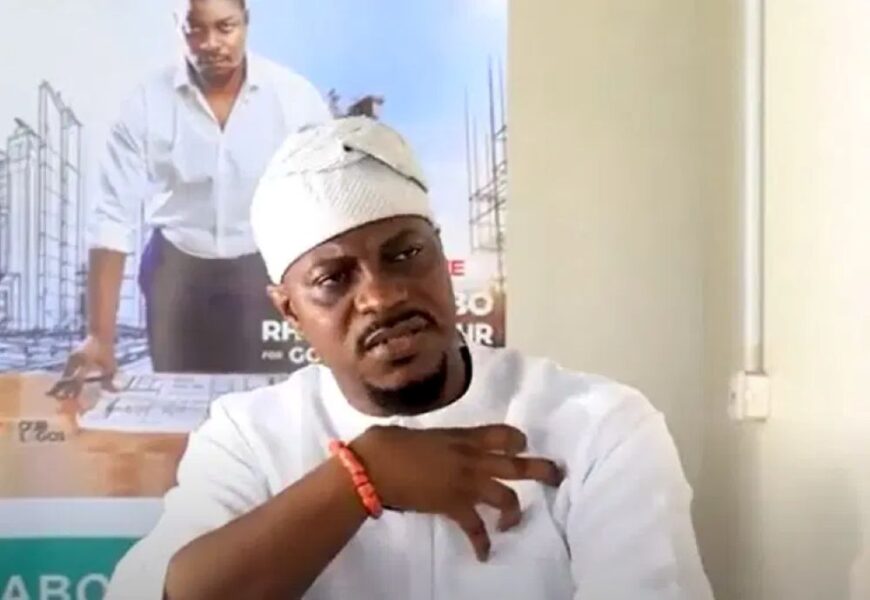

Former Lagos State governorship candidate, Gbadebo Rhodes-Vivour, has reaffirmed his commitment to the African Democratic Congress (ADC), distancing himself from the wave of defections and political realignments currently reshaping Nigeria’s opposition landscape.
In a statement issued on Tuesday and addressed to Lagos residents as well as ADC supporters, Rhodes-Vivour acknowledged the turbulence within opposition ranks, noting that several politicians have opted to pursue their ambitions on alternative platforms.
He expressed respect for those who have chosen to leave, describing their decisions as difficult but understandable under prevailing political conditions.
“Our politics is turbulent, the unity of the opposition is being tested, and for some, it has become necessary to forge different paths,” he said, adding that divergent political choices do not negate the shared objective of building a better Nigeria.
Despite the shifting alliances, Rhodes-Vivour made it clear that his allegiance remains firmly with the ADC, which he described as a platform built on conviction and sustained effort rather than political expediency.
“I am staying in the African Democratic Congress. It is the platform we have built, the ground we have fought on, and the vehicle that can take us to victory,” he stated, emphasising that his decision is rooted in principle rather than convenience.
Reflecting on his political trajectory, the former governorship candidate under Labour Party (LP) traced his journey across multiple parties, including KOWA, the Peoples Democratic Party (PDP), and the Labour Party.
According to him, each transition was driven by ideological considerations and a commitment to integrity.
“My political journey has always been guided by conviction. When a platform could no longer serve the people honestly, I moved on out of principle,” he noted.
Rhodes-Vivour also reiterated his stance against aligning with the ruling All Progressives Congress (APC) in Lagos State, asserting that he had consistently rejected offers that conflicted with his values.
“I have never compromised with the APC in Lagos — not when it was convenient, not when agreements were put on the table, and not when significant financial inducements were involved,” he said.
He further stressed the importance of political organisation and grassroots mobilisation in safeguarding electoral mandates, arguing that effective opposition politics in Nigeria requires discipline and preparedness at all levels.
“To protect the people’s mandate, there must be the capacity to defend it from the polling unit to the collation centre,” he said, underscoring the need for robust structures capable of withstanding electoral challenges.
Rhodes-Vivour disclosed that efforts to strengthen opposition structures in Lagos have continued since the 2023 general elections, with renewed focus on ward-level mobilisation and coordination across local government areas.
He emerged as the Labour Party’s governorship candidate during the 2023 elections, running a high-profile campaign that attracted significant youth support.
However, he was defeated by the incumbent governor, Babajide Sanwo-Olu of the APC.
Nigeria’s opposition space has since witnessed increasing fragmentation, with key figures switching allegiances among parties such as the Labour Party, PDP, and newer coalition platforms, including the ADC.
Recent developments have further underscored this trend.
Former Labour Party presidential candidate Peter Obi, alongside ex-Kano State governor Rabiu Kwankwaso, recently joined the Nigeria Democratic Congress (NDC), calling for unity and a shift away from protracted legal disputes within the opposition.
Their move, announced in Abuja, is widely seen as part of broader political manoeuvring ahead of the 2027 general elections, highlighting the fluid and evolving nature of Nigeria’s opposition politics.