
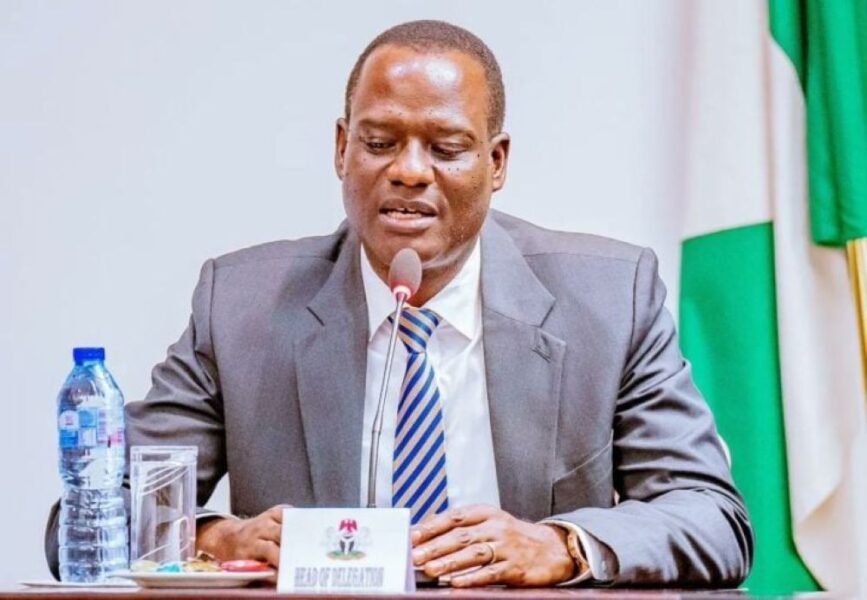

Nigeria’s Minister of Finance and Coordinating Minister of the Economy, Taiwo Oyedele, has reaffirmed the Federal Government’s position against reinstating the fuel subsidy, despite mounting public pressure over the rising cost of living.
Speaking on Tuesday in Paris, France, during a high-level meeting with global investors alongside President Bola Tinubu, Oyedele maintained that the subsidy regime created structural inefficiencies in the economy and would not be revisited.
He further stressed that the government would not impose price controls on petroleum products, arguing that market forces remain the most effective mechanism for determining fuel prices.
“We will not bring back fuel subsidy because it creates distortions for the economy, and we won’t introduce price control because we believe in the market,” Oyedele said, adding that evolving geopolitical dynamics, including developments in Iran, could open new investment opportunities for Nigeria in the global energy market.
The federal government’s stance comes against the backdrop of worsening economic conditions following the removal of the petrol subsidy in May 2023.
The policy shift triggered a sustained surge in inflation, with headline inflation climbing from 22.41 per cent in May 2023 to 34.19 per cent by June 2024, its highest level in nearly two decades.
Rising fuel costs significantly impacted transportation and food prices, with food inflation surpassing 39 per cent by October 2024.
Analysts attribute the spike to a combination of subsidy removal and currency devaluation, which together drove transport costs up by nearly 300 per cent and deepened poverty levels nationwide.
Addressing investors at the Paris meeting, President Tinubu defended the reform, describing subsidy removal as a necessary step to stabilise Nigeria’s foreign exchange market.
According to a statement issued by his special assistant on social media, Dada Olusegun, the president said the country had achieved relative stability in its FX regime since eliminating what he described as a major fiscal burden.
“Subsidy that was a burden to the entire country was removed, and ever since we have achieved FX stability,” Tinubu stated.
Further reinforcing the administration’s position, the President’s Adviser on Information and Strategy, Bayo Onanuga, noted that the reform agenda is designed to eliminate economic distortions, strengthen macroeconomic fundamentals, and lay the groundwork for inclusive growth.
Tinubu also reiterated his administration’s commitment to policy continuity, transparency, and fiscal discipline, assuring investors of consistent implementation of reforms across key sectors.
Highlighting recent economic performance, Oyedele disclosed that Nigeria recorded an 11.2 per cent growth in Gross Domestic Product (GDP) in dollar terms in 2025, underscoring the government’s ambition to build a $1 trillion economy by 2030.
He added that the administration’s immediate priority is to ensure that macroeconomic reforms translate into tangible improvements in the lives of Nigerians, pledging to enhance transparency through the publication of quarterly financial reports.
Also speaking at the meeting, Director-General of the Debt Management Office, Patience Oniha, assured investors of Nigeria’s prudent approach to debt management, emphasising sustainability and responsible borrowing practices.
The investor engagement featured representatives from major global financial institutions, including Citibank, Amundi, BlueCrest, Ninety One, Kirkoswald Capital, Principal Finisterre, Prudential Global Investment Management (PGIM), and Mesarete Capital.
President Tinubu, who departed Nigeria on Sunday for a three-nation diplomatic tour, reiterated that his administration remains committed to deepening structural reforms, improving transparency across the oil sector, and strengthening national security through measures such as decentralising policing and disrupting illicit financial flows.
“The focus remains on policy stability and diligent execution to ensure these strategic shifts translate into concrete benefits for all Nigerians,” the president said.
Some of the investors commended the government’s reform trajectory and expressed cautious optimism about Nigeria’s economic outlook.
In response to a question on his post-2027 agenda, Tinubu pledged to consolidate fiscal discipline, strengthen transparency frameworks, and maintain policy consistency.