
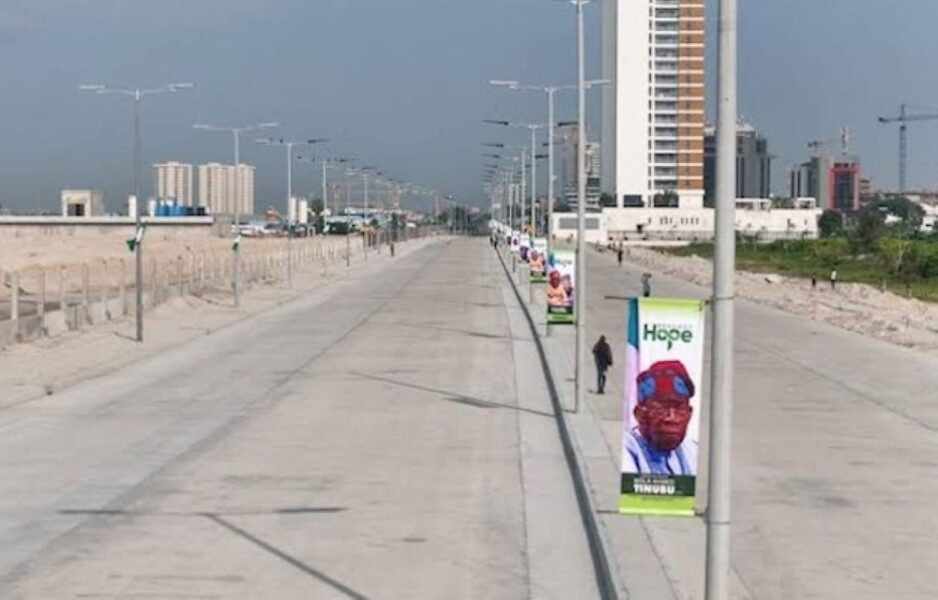

Tension is mounting in several Ibeju-Lekki communities following allegations that a major drainage outlet along the Lagos-Calabar Coastal Highway corridor in Eleko has been obstructed, raising fears of widespread flooding and possible displacement of residents.
Leaders under the umbrella of the Ibeju-Lekki Ancestral Community Foundation voiced their concerns during a stakeholders’ gathering held at the Eleko Town Hall on Sunday.
The foundation represents more than 53 indigenous communities, including Eleko, Museyo, Opo Ijebu and surrounding settlements.
Residents who spoke at the meeting warned that the ongoing highway construction could expose homes and businesses to severe flooding, especially during the peak of the rainy season.
According to a Punch reporter who visited the community, many structures located close to the coastal road corridor now appear lower than the newly constructed road level, fuelling concerns that runoff water may overflow into adjoining communities.
Community representatives also identified a water channel which they claimed had been sealed off as part of the road construction process.
Speaking on behalf of the affected communities, Chief Adebayo Agbabiaka said the people were not resisting development but were alarmed by what they described as inadequate environmental planning around the project.
According to him, the drainage channel being affected is a major water passage capable of carrying large volumes of rainwater away from the area.
“This drainage is about nine to 10 metres wide. Even a small downpour will be catastrophic. We are not against development, but there is no way the houses here will survive heavy rainfall if the water has nowhere to pass,” he said.
Agbabiaka alleged that the blockage of the drainage route appeared intentional, arguing that no alternative channel had been created to redirect water flow.
“We believe this was deliberately done to force us out of our communities. If not, why would the only channel through which water flows be blocked without creating an alternative route?” he asked.
He further claimed that authorities were aware that repeated flooding could eventually compel residents to abandon their ancestral homes.
“They know quite well that once people start experiencing flooding in their homes, they will begin to leave the area,” he added.
The community leader also renewed opposition to the proposed 150-metre setback policy linked to the Lagos-Calabar Coastal Highway project, insisting that enforcing such a measure would leave thousands of residents homeless.
“We have begged them repeatedly that the 150-metre setback is not acceptable. We have no other place to go. We have sacrificed a lot for the development of Nigeria,” Agbabiaka stated.
He noted that communities in the area had already given up substantial portions of land for major national projects, including the Lekki Free Trade Zone, Dangote Refinery and the Lekki Deep Sea Port.
“All we are asking is not to be uprooted from our ancestral homes. When the idea of the coastal road was conceived over 30 years ago, it was never meant to take away people’s homes. We have made enough appeals for a waiver,” he said.
Agbabiaka also expressed disappointment over a meeting held on April 4 between community representatives and government officials, saying the engagement did not adequately address residents’ concerns about the setback issue.
“The first thing we need assurance on is the waiver. We have given enough already — the free trade zone, the seaport, land for Dangote, and now the coastal road. We have sacrificed enough and do not want to go extinct,” he said.
Also addressing the gathering, the youth coordinator for the communities, Ganiyu Adewale, declared that residents had unanimously rejected any plan that could lead to relocation, adding that it was the project that came to meet the communities and not the other way round.
According to him, compensation or relocation would not resolve the concerns of the affected communities, whose primary demand remains a waiver from the setback arrangement.
He noted that indigenous communities across the Ibeju-Lekki axis had consistently borne the burden of large-scale development projects in the state.
“Despite the inconveniences, environmental impact, and social adjustments that followed, the communities endured these sacrifices in the interest of development,” he said.
“All we are asking the government to do is to grant us waivers, as they have done for others. We are human beings, too. This development must not be allowed to erase indigenous communities.”
Adewale disclosed that communities stretching from Opo Ijebu to Aboriji could be affected if the proposed setback policy is implemented.
Meanwhile, a source in the Federal Ministry of Works reportedly clarified that markings observed along the highway corridor were carried out by the Office of the Surveyor General of the Federation and were not necessarily an indication of imminent demolition.
According to the source, the markings were intended to identify areas that fall within federal government property.
The Lagos-Calabar Coastal Highway is one of the federal government’s flagship infrastructure projects designed to connect Lagos to Calabar through several coastal states, including Ogun, Ondo, Edo, Delta, Bayelsa, Rivers, Akwa Ibom and Cross River.
Despite its projected economic benefits, concerns over displacement, demolitions and environmental impact continue to trail the project in several affected communities.