
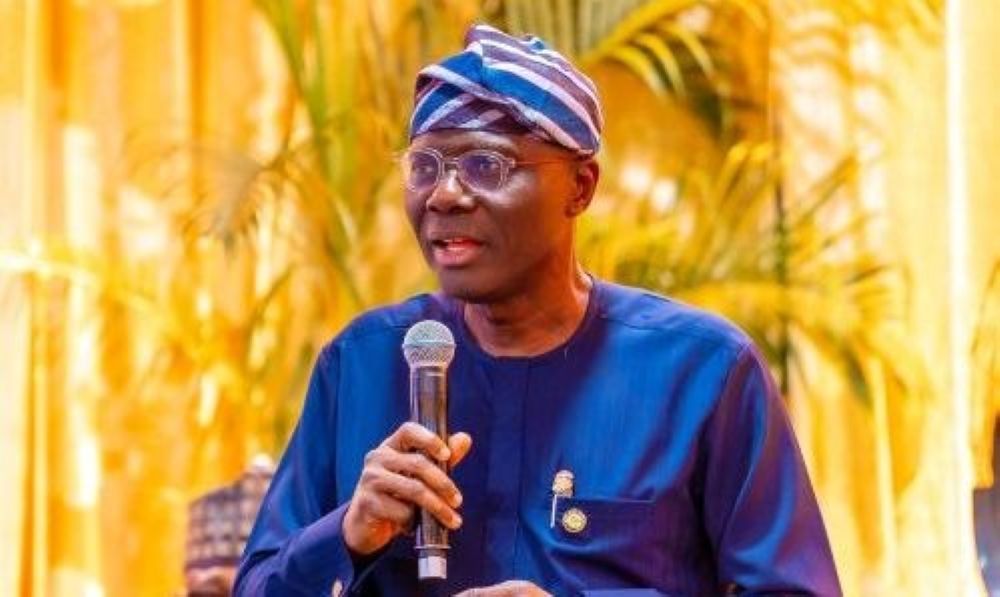

Lagos State Governor Babajide Sanwo-Olu has reaffirmed the state’s commitment to the South-West region, pledging to strengthen economic integration and collaboration among states in the zone to boost development and shared prosperity.
Sanwo-Olu, who chairs the South-West Governors’ Forum, made the commitment on Saturday while delivering a keynote address at the Geo-Economic Optimisation Summit Lagos 2026, organised by the Citadel School of Government in Oregun, Lagos.
Speaking on the theme “From South-West Nigeria to the Globe: Lagos State as a Geoeconomic Hub”, the governor said Lagos would continue to play a leading role in promoting regional cooperation as a pathway to sustainable economic growth.
According to a statement issued by his Special Adviser on Media and Publicity, Gboyega Akosile, Sanwo-Olu described Lagos as Africa’s foremost geoeconomic hub, leveraging its strengths in trade, infrastructure, finance, technology and human capital to drive economic opportunities across Nigeria and the wider West African region.
He urged political and economic leaders in the South-West to embrace a coordinated development strategy, stressing that regional collaboration would yield greater benefits than isolated efforts.
“Think regionally, act strategically, and cooperate generously, for no single state captures the whole prize alone,” the governor said.
Reaffirming Lagos’ place within the South-West, Sanwo-Olu added that the state would continue to champion initiatives that foster stronger ties and economic integration among states in the region.
Highlighting Lagos’ economic significance, the governor said the state accounts for roughly one-third of Nigeria’s gross domestic product and remains Africa’s second-largest metropolitan economy after Cairo, with an output estimated at more than $259.75 billion on a purchasing power parity basis.
He noted that if Lagos were assessed as an independent country, it would rank among Africa’s largest economies, driven largely by sectors such as finance, technology, trade, logistics, creative industries and the blue economy, which collectively contribute more than 90 per cent of the state’s economic output.
Sanwo-Olu also outlined major infrastructure projects aimed at sustaining Lagos’ economic growth, including the operational Blue and Red Rail Lines, the proposed Green Line, ongoing improvements to the Lagos-Badagry Expressway, and federal-backed projects such as the Coastal Highway and the Sokoto-Badagry Superhighway.
The governor further renewed calls for a constitutional special status for Lagos, arguing that the state’s historical role as Nigeria’s former federal capital, its strategic economic importance and the demands associated with hosting a significant share of the nation’s population justify such recognition.
“We will continue to press the case for a special status designation for Lagos, grounded in our history as a former federal territory, our strategic importance to the national economy, and the immense burdens we carry. We believe Lagos deserves that recognition,” he said.
Sanwo-Olu assured local and international investors that Lagos remains open to partnerships capable of accelerating economic growth and sustainable development.
In his remarks, Pastor Tunde Bakare, founder and chairman of the Citadel School of Government, described Lagos as a benchmark for sub-national economic development in Nigeria, attributing its success to long-term planning, institutional continuity and strategic investments.
Similarly, Sunday Adebisi, Executive Director of the University of Lagos Business School, said Lagos had grown beyond its traditional role as Nigeria’s commercial capital to emerge as a geoeconomic powerhouse with influence across West Africa and beyond.