
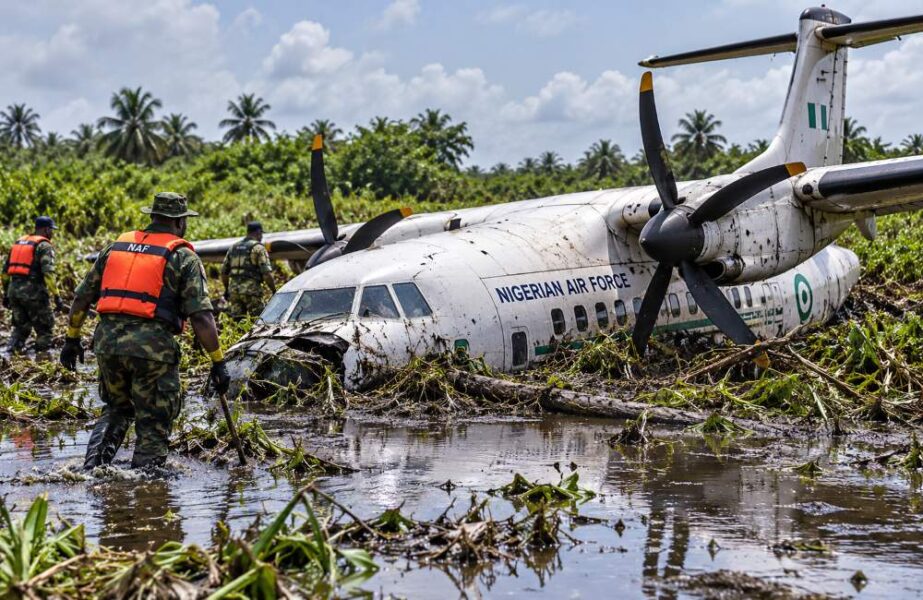

The Nigerian Air Force (NAF) has begun efforts to recover the flight data recorder and cockpit voice recorder of its ATR-42 aircraft that crashed into a swamp in Igbokoda, Ondo State, as difficult terrain continues to hamper efforts to retrieve the submerged wreckage.
The search for the two critical recording devices comes as military personnel, divers and other recovery teams struggle to reach the main body of the aircraft, which crashed near the Nigerian Navy’s Forward Operating Base in Igbokoda, headquarters of Ilaje Local Government Area.
All 25 people aboard the aircraft, comprising 20 passengers and five crew members, died in the October 5 crash.
NAF Superintendent of Standards and Evaluation, Air Vice Marshal Ebimobo Ebiowe, disclosed the latest development to journalists at the crash site on Friday, October 9.
He said investigators were searching for critical components of the aircraft that could provide evidence to establish the circumstances surrounding the tragedy.
“We hope to be able to find critical components of the aircraft that will speak to the investigators because the aircraft wreckage actually speaks to the investigators,” Ebiowe said.
He identified the flight data recorder (FDR), commonly known as the black box, and the cockpit voice recorder (CVR) as two important components investigators hoped to recover.
The FDR records information about an aircraft’s performance and flight parameters, while the CVR preserves cockpit conversations, alarms and other sounds that could help investigators reconstruct events leading up to an accident.
Recovering the devices could therefore provide crucial evidence for the investigation, although their findings would need to be assessed alongside physical evidence from the wreckage and other available records.
Submerged wreckage poses recovery challenge
The aircraft was on a routine mission from Benin City, Edo State, to Lagos when it crashed into the swamp near the naval base.
The impact reportedly broke the aircraft into two, with its main body becoming submerged in water at the crash site.
The difficult terrain and poor underwater visibility have significantly complicated recovery operations, preventing rescuers from reaching the main wreckage despite sustained efforts.
Military personnel and local divers have continued searching the area, recovering fragments of the aircraft and human remains.
The Ondo State Government subsequently deployed heavy-duty amphibious equipment, including swamp buggies, to improve access to the site and support the recovery operation.
The equipment has helped create pathways through the difficult terrain, but the main wreckage has yet to be retrieved.
Recovery workers have also raised concerns about environmental conditions at the site, including the stench from decomposing human remains and aviation fuel floating on the surrounding water.
The conditions have added to the difficulties facing personnel working to recover the victims and aircraft components.
Navy deploys sonar equipment
The Nigerian Navy has deployed specialised sonar-scanning equipment to help locate the submerged aircraft and guide recovery teams.
Chief of the Naval Staff, Vice Admiral Idi Abbas, directed the Nigerian Navy Hydrographic Department to deploy personnel and advanced equipment to obtain an underwater picture of the crash site.
The sonar survey is expected to help establish the precise location of the wreckage, allowing divers and technical personnel to focus their recovery efforts.
The operation is also receiving support from Nigerian Navy divers and NAF drone pilots conducting searches around the surrounding mangrove and forested areas.
The information obtained from the underwater survey could prove particularly important in locating the flight recorders and other components needed for the investigation.
Air chief promises comprehensive investigation
Chief of the Air Staff, Air Marshal Sunday Aneke, visited the crash site on Thursday and assured Nigerians that the military would conduct a comprehensive investigation into the incident.
Aneke said a high-level team comprising military and civilian aviation safety experts had been constituted to determine what went wrong and recommend measures to prevent a recurrence.
According to him, the team would include safety specialists, representatives of the Nigerian Safety Investigation Bureau and the Accident Investigation Bureau, emergency management agencies, retired senior military officers and experienced NAF personnel.
He urged Nigerians to avoid speculation while investigators work to establish the circumstances surrounding the crash.
The investigation is expected to examine available evidence from the aircraft, its recovered components and other relevant sources to determine the factors that contributed to the accident.
Igbokoda monarch proposes alternative recovery method
Meanwhile, the traditional ruler of Igbokoda, Afolabi Odidiomo, has offered to mobilise community support if conventional recovery methods fail to retrieve the submerged aircraft.
Odidiomo said the community had begun exploring alternative ways to pull the wreckage out of the swamp, including using a large locally made boat and chains.
“Now that the Afibian excavator has been able to create paths to that place, we are also waiting to see what it can do. If it cannot do anything and it can locate whatever is left of the plane, I can assure you that we’ll bring it out,” he said.
He explained that community members were discussing the possibility of taking a large boat to the location, securing chains around the wreckage and using the boat to pull it out.
“We have started meeting, discussing the possibility of how to bring it out, and it might not be the orthodox way,” the monarch added.
However, the proposed approach would depend on locating the wreckage and determining whether it could be safely secured and moved.
Odidiomo also expressed concern about the difficult recovery conditions, particularly the presence of human remains in the surrounding water.