
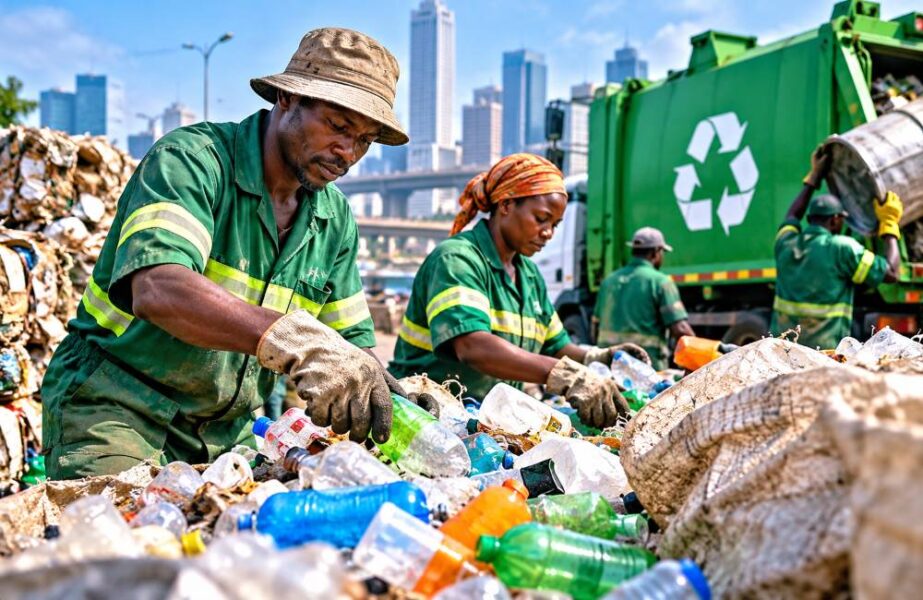
Waste pickers in Lagos State have called for stronger implementation of Nigeria’s recycling and waste-management policies, saying better enforcement could improve livelihoods, strengthen environmental protection and create cleaner communities.
President of the Association of Scrap and Waste Pickers of Lagos State (ASWOL), Friday Oku, made the call in an interview in Lagos on Wednesday as Nigeria prepares to mark its 66th Independence anniversary.
Oku said recent developments in extended producer responsibility (EPR), plastic-waste management and the circular economy had opened new opportunities for waste pickers, recyclers and other operators in the informal waste sector.
He described the first three years of President Bola Tinubu’s administration as a period of significant policy development in the environmental sector, particularly in regulation, circular-economy development and efforts to address plastic pollution.
“From the perspective of waste pickers, recyclers and other informal-sector operators, I would describe the last three years as a period of important policy development,” Oku said.
However, he said a significant gap remained between policy formulation and implementation, stressing that effective waste management required stronger collaboration among the federal, state and local governments.
Oku identified EPR, plastic-waste management, electronic waste and circular-economy initiatives as areas where notable policy developments had taken place.
He particularly highlighted EPR, which requires producers to take responsibility for products and packaging after they are consumed.
According to him, the National Environmental Standards and Regulations Enforcement Agency (NESREA) has recognised EPR arrangements covering plastics, used tyres, e-waste and used batteries.
He also cited the National Policy on Plastic Waste Management and the GEF-funded Circular Solutions to Plastic Pollution in Nigeria project as part of efforts to address plastic pollution.
Another development, he said, was the National Environmental (Battery Control) Regulations, 2024, also known as S.I. No. 11 of 2024.
Oku stressed the importance of enforcing environmental regulations against recycling facilities that fail to meet required standards, particularly where hazardous materials are involved.
He, however, cautioned against describing the developments as evidence of a major nationwide improvement in recycling, saying available data remained insufficient to support such a conclusion.
“There are signs of progress, but I would be cautious about claiming that Nigeria has achieved a major nationwide improvement in recycling based on the available evidence,” he said.
As an indication that recyclable materials were entering recycling markets, Oku pointed to Nigeria’s export of about 5.85 million kilogrammes of certain plastic waste and scrap in 2024.
He said, however, that the figure alone could not determine the overall effectiveness of government interventions because of weaknesses in Nigeria’s national waste data.
“Without reliable national data, it is difficult to accurately measure the overall impact of government interventions,” Oku said.
According to him, greater attention should be given to waste collection and material recovery at the community level.
He said reliable data would help authorities assess whether existing policies were improving waste recovery, reducing pollution and producing measurable environmental benefits.
Oku also called for increased investment in waste-management infrastructure, source separation and recycling systems across cities and communities.
“Separating recyclable materials at source would reduce contamination and prevent valuable materials from ending up in dumpsites,” he said.
On EPR, the ASWOL president urged authorities to strengthen implementation by ensuring that producers contribute financially and operationally to the collection and recycling of products placed on the Nigerian market.
He said effective implementation of EPR could improve recycling rates while encouraging manufacturers to consider the environmental consequences of their products and packaging after consumption.
Oku also called for greater recognition of waste pickers as part of Nigeria’s waste-management system.
He advocated training, occupational safety equipment, access to finance and opportunities for informal-sector operators to participate in recognised waste-management programmes.
According to him, increased investment in recycling enterprises could expand material recovery while creating more green jobs for Nigerians.
The ASWOL president further urged the government to establish clear national targets for waste collection, source separation, recycling, open dumping and open burning.
He said such targets should also measure plastic waste entering waterways, producer participation in EPR schemes and the number of properly regulated recycling facilities across the country.