
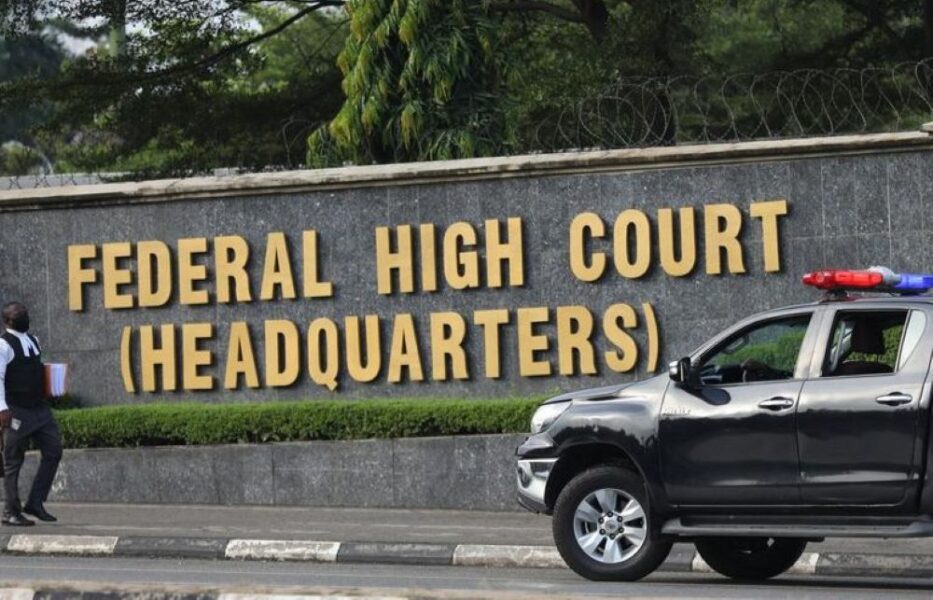

The Federal High Court has introduced new Pre-Election Practice Directions for 2026, replacing the 2022 guidelines with a framework designed to accelerate the hearing and determination of election-related disputes across Nigeria.
The new practice directions, issued by the Chief Judge of the Federal High Court, Justice John Tsoho, were announced on Tuesday in a statement.
They are intended to promote fairness, impartiality and the speedy resolution of pre-election matters ahead of future electoral contests.
According to the statement, the revised rules are aimed at ensuring that parties concentrate on issues genuinely in dispute, reducing the time spent on interlocutory applications, encouraging amicable settlements where possible and limiting unnecessary adjournments that often delay proceedings.
“The Federal High Court of Nigeria hereby notifies members of the Bar, political parties, litigants and the general public that the Honourable the Chief Judge of the Federal High Court, Honourable Justice John Terhemba Tsoho, OFR, has issued the Federal High Court (Pre-Election) Practice Directions, 2026. It is instructive that the current Practice Directions have repealed the 2022 version,” the statement said.
A copy of the new practice directions attached to the statement provides that the Federal High Court (Civil Procedure) Rules, 2019, will apply to issues not expressly covered by the new guidelines.
The court also directed judges handling pre-election matters to pay particular attention to relevant provisions of the Electoral Act, 2026, including Sections 29(5), (6) and (7), 83(5) and (6), 88(1)-(4), as well as Section 285(14)(c) of the 1999 Constitution (as amended).
To ensure effective adjudication, any party challenging the conduct or outcome of a political party’s primary election must include all relevant parties as respondents in the suit.
Recognising the time-sensitive nature of pre-election litigation, the court ordered that registries in all judicial divisions remain open on Saturdays, Sundays and public holidays from 10:00 a.m. to 2:00 p.m. exclusively for filing pre-election cases.
Under the new rules, every pre-election matter must be initiated through an Originating Summons in the prescribed forms under the Federal High Court (Civil Procedure) Rules.
However, where allegations involve fraud, forgery or other highly contentious facts, parties are required to provide detailed particulars of the claims, which may be established through oral testimony from witnesses or documentary evidence presented before the court.
The practice directions also empower the court and litigants to summon witnesses or compel the production of documents where necessary for the determination of a case.
As part of efforts to modernise court proceedings and speed up case management, the guidelines permit the use of electronic mail and other digital communication channels to notify lawyers of urgent court activities.
Judges are also authorised to conduct proceedings through virtual hearings where appropriate.
To prevent delays, the practice directions require courts to fix hearing dates within seven days after parties have completed the exchange of court processes.
Pre-election matters are to receive priority until final judgment is delivered.
The guidelines further provide that where a party fails to appear for a scheduled hearing despite having been duly notified, the court may, either on its own initiative or upon an oral application by the opposing counsel, deem the absent party’s written address as adopted.
In addition, the court directed that no party should receive more than two adjournments in any pre-election matter, underscoring its commitment to ensuring the timely resolution of election disputes in line with constitutional and statutory timelines.
The Federal High Court said the new practice directions are consistent with the provisions of the Constitution, the Electoral Act, 2026, and other applicable laws governing pre-election litigation in Nigeria.