
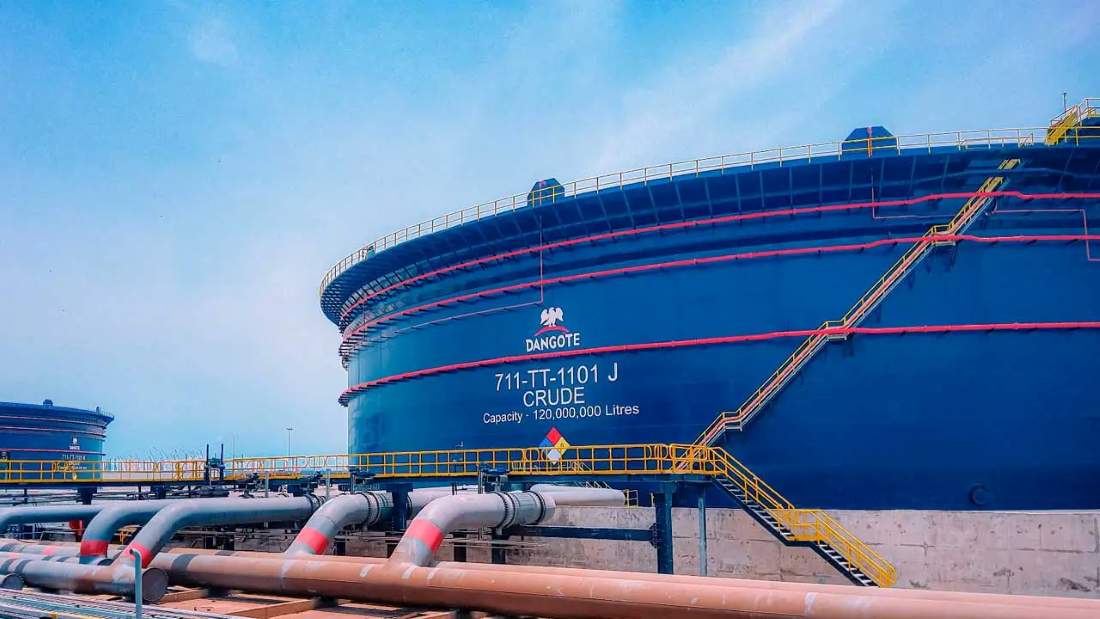

The management of Dangote Petroleum Refinery has dismissed allegations that petroleum products refined at its facility are exported to Lomé, Togo, before being re-imported into Nigeria, describing the claims as false and economically unsound.
In a statement shared on its official X account on Tuesday, the refinery said recent reports circulating online suggesting that its products are shipped to neighbouring countries and later brought back into Nigeria do not reflect commercial realities or established trade practices.
The company said it was compelled to address the allegation despite its longstanding policy of avoiding engagement with what it described as baseless and unsubstantiated claims.
According to the refinery, the alleged arrangement is inconsistent with its commercial objectives, business model and commitment to strengthening domestic fuel supply.
“As a matter of policy, we do not respond to baseless and unsubstantiated claims, given our current determination and focus on ensuring energy security in Nigeria and Africa as a whole,” the statement said.
“However, we have decided to clear the air on this ill-motivated web of falsehoods for posterity.”
The refinery explained that one of its strategic priorities is to remain a dominant supplier of petroleum products within Nigeria, making it illogical to support any arrangement that would encourage imports competing directly with its output.
It stressed that facilitating such transactions would undermine its position in the domestic market and contradict its broader business objectives.
The company further disclosed that its sales agreements and tender conditions explicitly prohibit buyers from reselling or re-importing its products into Nigeria.
Addressing the economic implications of the allegation, the refinery noted that transporting petroleum products from its facility to Lomé and then shipping them back to Nigeria would attract substantial logistics expenses.
According to the company, the estimated cost of such a process ranges between $80 and $90 per metric ton, making the practice commercially unattractive and significantly reducing profit margins.
It added that it does not provide export discounts that could offset these costs or create arbitrage opportunities between export and domestic markets.
“Simply put, there is no evident commercial incentive for a producer to incur additional shipping, storage, financing and handling costs only for the product to return and compete in its largest and closest market,” the statement said.
The refinery also highlighted its compliance and monitoring mechanisms, stating that it maintains detailed records of all product sales, including lifting points, nominated vessels, counterparties and declared destinations where necessary.
It said these procedures make any suggestion that it knowingly supports the re-importation of its products inconsistent with its contractual obligations and internal compliance framework.
The company reiterated its longstanding advocacy for reducing Nigeria’s dependence on imported petroleum products, arguing that excessive imports weaken local refining capacity, increase pressure on foreign exchange reserves and hinder industrial growth.
“It would therefore be inconsistent with both the refinery’s commercial interests and its publicly stated position to support or encourage practices that increase imports into Nigeria,” the management stated.
The refinery maintained that there is neither a commercial nor strategic justification for exporting products to neighbouring countries only for them to be returned to Nigeria.
It insisted that the allegation is not supported by trade economics, contractual arrangements, product traceability measures or its commitment to promoting local refining and reducing the country’s reliance on imported fuel.