
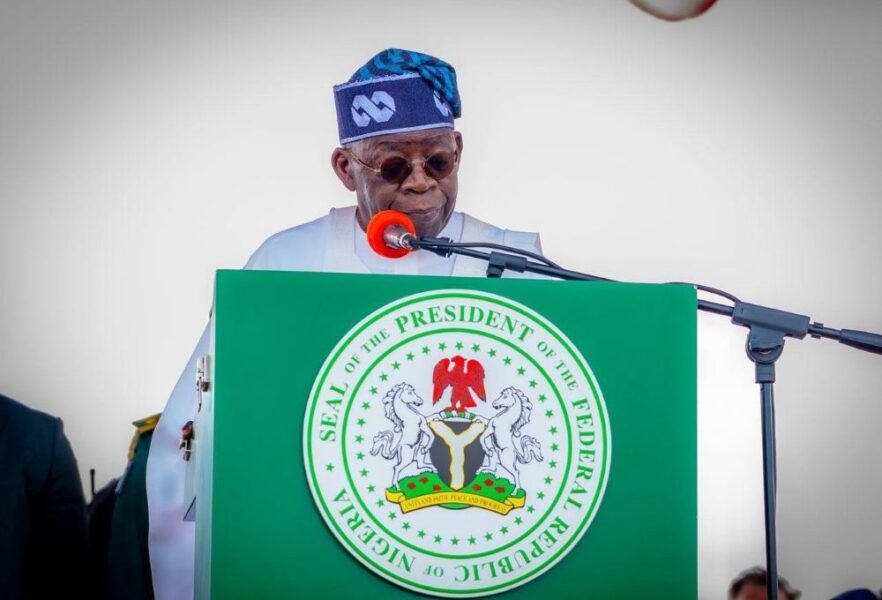

President Bola Tinubu has proposed a N3.15 trillion reduction in Nigeria’s 2026 federal budget, seeking National Assembly approval to bring total government expenditure down from N68.32 trillion to N65.18 trillion.
Despite the proposed reduction, the President wants the government to retain its N31.46 trillion fiscal deficit and existing borrowing plan.
Tinubu’s proposal is contained in a bill seeking to repeal and re-enact the 2026 Appropriation Act, alongside a revised Federal Government Fiscal Framework.
In a letter dated November 20, 2026, addressed to the Speaker of the House of Representatives, Tajudeen Abbas, the President requested lawmakers’ approval for the proposed changes.
Abbas read the letter during plenary on Tuesday, November 24, 2026.
Under the revised fiscal framework, aggregate expenditure will fall from the previously approved N68.323 trillion to N65.176 trillion, representing a reduction of N3.147 trillion.
Projected Federal Government revenue, including earnings from Government-Owned Enterprises, stands at N33.720 trillion, while aggregate capital expenditure is pegged at N26.232 trillion.
Why Tinubu wants to revise the 2026 budget
Explaining the proposed adjustments, Tinubu said the revision was necessary to align government spending with existing financial obligations and available resources.
According to the President, the changes would regularise some expenditures incurred by the Nigerian National Petroleum Company Limited (NNPCL) on behalf of the Federation, address underprovided debt-service obligations, recognise issued capital warrants and supplementation commitments, and provide refunds to Ministries, Departments and Agencies (MDAs) and special accounts.
He explained that most capital provisions for MDAs comprised amounts already warranted, while a limited number of new capital and overhead allocations had been introduced to accommodate priority national interventions.
Tinubu said the additional provisions would support the completion of critical road projects, protect agricultural production, reduce production costs, improve farm yields, enhance market access and address water vulnerability.
In the letter, he stated that the adjustments would prioritise existing commitments, improve the credibility and execution of the capital budget, and maintain fiscal restraint.
FG retains N31.46trn deficit and N29.22trn borrowing plan
Despite the proposed N3.15 trillion reduction in expenditure, the Federal Government intends to maintain its N31.457 trillion fiscal deficit, equivalent to 5.64 per cent of the country’s Gross Domestic Product (GDP).
The proposed new borrowing also remains unchanged at N29.218 trillion.
This comprises N18.428 trillion in domestic borrowing and N10.790 trillion in foreign borrowing.
Tinubu further explained that the proposed $7.7 billion external loan, estimated at approximately N10.368 trillion using an exchange rate of N1,346.50 to the dollar, would finance the existing foreign borrowing provision.
According to him, the proposed external borrowing would not increase the overall borrowing envelope under the revised fiscal framework.
The figures indicate that although the government intends to reduce its overall spending plan, it does not propose a corresponding reduction in its borrowing targets or fiscal deficit.
Tinubu seeks speedy passage of revised appropriation
Seeking lawmakers’ cooperation, the President urged the House of Representatives to expedite consideration and passage of the bill.
He said the revised appropriation was necessary to facilitate the orderly implementation of the budget and settlement of outstanding government obligations.
The proposed changes will, however, require legislative approval before the revised spending plan can take effect.
What you should know about the 2026 budget
Tinubu signed the N68.323 trillion 2026 Appropriation Bill into law in April 2026 after the National Assembly approved the spending plan.
The budget provided N4.799 trillion for statutory transfers and N15.8 trillion for debt servicing.
It also allocated N15.4 trillion for recurrent expenditure, while N32.2 trillion was earmarked for capital expenditure through the Development Fund.
According to the Presidency, capital spending accounted for approximately 50 per cent of the total budget, reflecting the administration’s stated priorities of economic stability, national security, infrastructure development and inclusive growth.
Tinubu also signed a separate bill extending the implementation period of the capital component of the 2025 budget from March 31, 2026, to June 30, 2026.