
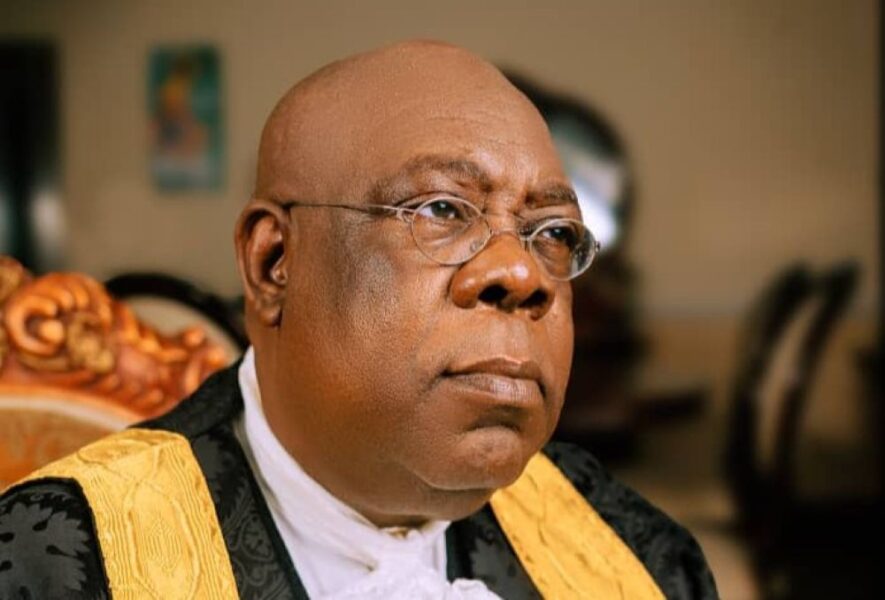

By Kunle Kalejaye (SAN)
Chief Jonathan Akinremi Odebiyi (1923 – 2005) was a Minister of Education in the Obafemi Awolowo government in the Western Region, Nigeria. He was a politician with an intellectual bent. He subsequently went ahead to establish a secondary school he named Eyinni High School in Ibadan. He gave the school a French motto: Le droit c’est le pouvoir. As a philosophical maxim, it means: right is might! Very profound. It is also an old legal maxim: “le droit, c’est le pouvoir” – law is power.
Its most cynical interpretation and inversion currently plays out in the theater of Nigerian politics. When power precedes the law, the rules of the state become nothing more than tools in the hands of those who command the highest authority. This dangerous reality was laid bare when the Minister of the Federal Capital Territory, Nyesom Wike, sparked nationwide outrage by claiming that if President Bola Tinubu had wanted to win the August 2026 Osun State governorship election “at all costs”, he would have been deployed to secure a victory that the incumbent governor could do nothing to stop. While it may be tepidly argued that it is intended as a defense of the administration’s non-interference, the statement reinforces and acts as an explicit admission and even a verbal demonstration of the dark mechanics of electoral subversion in Nigeria. By stating that an election could be won if the president simply chose to deploy him, Wike did not praise democratic fairness. Instead, he publicly validated the belief that the state possesses an unofficial but sure apparatus capable of overriding the collective will of the electorate. It reduces democratic elections from a contest of service and ideas into a transactional display of state-backed brute force and power.
Nigeria’s democratic history is heavily burdened by the legacy of “garrison politics” and structural manipulation, monetary inducement and display of raw coercive powers of state. “Garrison politics” refers to a deeply entrenched system where democratic processes are bypassed and replaced by military-style force, patronage networks, and political thuggery. Chief Lamidi Adedibu, the late political godfather of Oyo State, was the quintessential example of garrison politics in Nigerian local history. He ruled from his Molete palace. Politicians and political office seekers visited him to be annointed! He bestrode South-West politics like a collosus and even had the temerity to remove a sitting governor!
So, Minister Wike’s dangerous rhetoric flows directly from the historical precedent of executive overreach and lawlessness where previous deployments of “federal might” have long cast a dark shadow over Nigerian democracy. The country’s political history is rife with instances where federal power, security agencies, and state resources were weaponised to overturn the local electorate’s will, from the Second Republic to the 2003 and 2007 “do-or-die” polls, and the heavily militarised 2014 and 2018 Ekiti gubernatorial elections. Wike’s comments actively undermine decades of reforms by normalising this political impunity, stripping the Independent National Electoral Commission (INEC) of its constitutional independence, and treating public office as a conquerable territory rather than a democratic trust.
Opposition parties reacted swiftly, with leaders calling the comments an open threat to the survival of multiparty democracy. Spokespersons from major opposition groups characterised the remarks as a Freudian slip that exposed the ruling political party and administration’s hidden blueprint for brutal electoral dominance. The mistarget and irony stick nevertheless, as even Minister Wike is not a member of the ruling party but speaks as if he is the chief coordinator of the ruling party. Opposition figures challenged the presidency to break its silence, warning that treating the constitutional rights of voters as a disposable executive privilege sets a dangerous precedent. They declared that the opposition would not be intimidated by boasts of state-sponsored electoral conquest and vowed to resist any undemocratic machinations heading into future polls.
Despite sharp condemnation from opposition parties, social commentators, and civil society groups, the response from the Aso Rock Presidential Villa has been total, ominous and deafening silence. In constitutional democracies, the presidency is expected to guard the rule of law. When a high-ranking cabinet member openly boasts about the capacity to subvert an election, the president’s failure to issue a public correction or distance the administration from the remarks creates a disturbing tacit endorsement. Consequently, holding a fair election is recast as a voluntary favor granted by the president, rather than a non-negotiable constitutional right.
This implicit quiet approval sends a troubling message to the public and to political actors gearing up for the upcoming 2027 general elections. For the voting public, this rhetoric fuels deep-seated pessimism, fostering an environment where citizens believe the outcome of future races has already been decided. When voters believe their choices can be overridden “at all costs”, the incentive to participate evaporates. Furthermore, for opposition parties, this shifts the pre-election landscape from a civil democratic contest into a high-stakes security calculation, raising the risk of political violence as actors build systems of resistance to counter perceived state aggression.
A fair, free and credible election is not a gift or a concession granted by an incumbent leader; it is the unarguable baseline of a free society. When a serving minister boasts of his ability to override the electorate, and the presidency responds with silence, the foundations of public trust are eroded. For Nigeria to safeguard its democracy ahead of 2027, its leaders must remember that true political legitimacy cannot be manufactured. It must be freely given by the citizens at the ballot box, where every vote must count.
Asiwaju Kalejaye, a senior advocate of Nigeria (SAN), is the founder and chairman of Eagle102.5 FM, Ilese-Ijebu

3 comments
www.555329.com
An Engaging Blog Post
pornip
The content is really great
pornip
That was amazing