
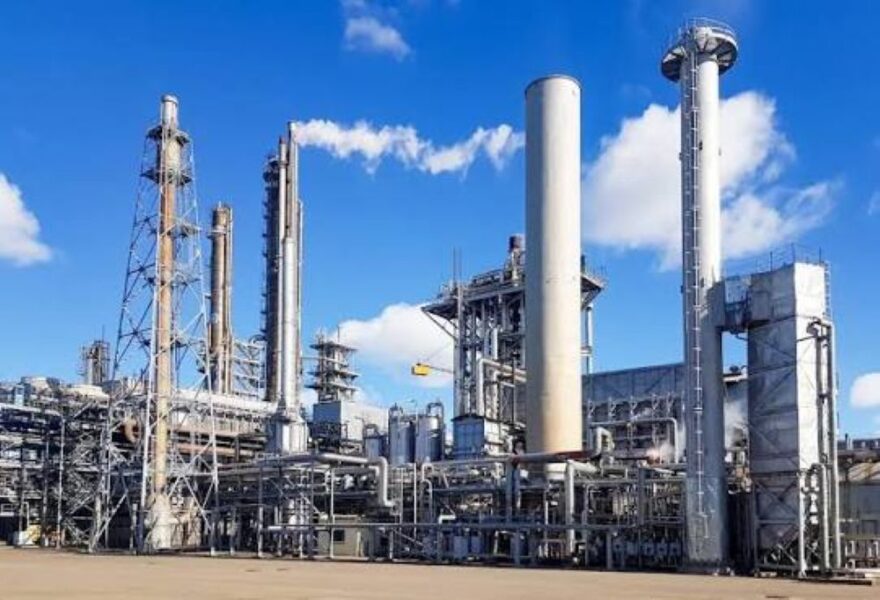

The Petroleum Products Retail Outlets Owners Association of Nigeria (PETROAN) has urged the Nigerian National Petroleum Company Limited (NNPC Ltd.) to convert its proposed refinery rehabilitation partnership into a binding agreement with clear performance targets and penalties for failure.
The association commended President Bola Tinubu for his renewed commitment to reviving Nigeria’s state-owned refineries, particularly his position that refinery performance should be judged by commercial results rather than visible activity.
PETROAN National President, Billy Gillis-Harry, described the President’s recent remarks at the State House, where he received the newly elected National Executive of the Nigeria Union of Petroleum and Natural Gas Workers (NUPENG), as a significant development in the debate over Nigeria’s refining industry.
Gillis-Harry particularly cited Tinubu’s observation that the “ordinary flame and smoke of a refinery doesn’t mean it’s working”, saying it represented a shift towards measurable indicators such as throughput, operating availability, margins and return on capital.
PETROAN also praised the president for accepting the assets and liabilities inherited from previous administrations, arguing that continuity of government obligations was important for restoring investor confidence.
“Technical partners do not price political sentiment. They price contractual certainty and the willingness of a sovereign to own inherited commitments,” the association said.
PETROAN said the need for a new approach was underscored by the history of refinery rehabilitation spending, noting that about $4.15 billion was allocated to interventions at the Port Harcourt, Warri and Kaduna refineries between 1993 and 2019.
It added that the Federal Executive Council approved a further rehabilitation package of about $3.14 billion in 2021, comprising $1.5 billion for Port Harcourt, $897.6 million for Warri and $740.67 million for Kaduna.
According to the association, the Port Harcourt refinery briefly resumed operations in late 2024 before shutting down on May 24, 2025, for maintenance initially expected to last 30 days.
PETROAN also cited an NNPC Ltd. internal assessment in February 2026 which reportedly found that the plants were operating at material losses, while the National Assembly had commenced an inquiry into the deployment of previous rehabilitation funds.
“The constraint was never primarily money. It was governance, technical ownership, accountability for outcomes, and the absence of any party whose commercial survival depended on the plants actually running,” PETROAN said.
The association maintained that restoring state-owned refineries remains strategically important despite the expansion of private refining capacity.
It said Nigeria’s petrol import bill declined from N2.271 trillion in the first quarter of 2025 to N87.4 billion in the corresponding period of 2026, while domestic refineries accounted for about 76.7 per cent of national petrol volumes during the period.
However, PETROAN warned that reliance on a small number of domestic suppliers could create a new supply risk.
“A market that has moved from import dependence to single-source dependence has changed the shape of its risk, not the size of it,” it said.
The association said returning the Port Harcourt and Warri refineries to their stated capacities of 210,000 barrels per day and 125,000 barrels per day respectively would provide an additional 335,000 barrels per day of geographically distributed refining capacity.
It said this would strengthen supply resilience, promote price discipline, improve regional balance and enhance Nigeria’s bargaining position in the downstream petroleum market.
On the proposed technical equity partnership involving NNPC Ltd., Sanjiang Chemical Company Limited and Xingcheng (Fuzhou) Industrial Park Operation and Management Co. Ltd., PETROAN welcomed the initiative but urged caution.
The association noted that the memorandum of understanding signed in April 2026 remains non-binding and subject to regulatory approval and further negotiations.
It therefore called for the MoU to be converted into a binding agreement containing defined completion dates, throughput guarantees, availability thresholds and enforceable liquidated damages for non-performance.
PETROAN also demanded greater transparency regarding the proposed equity structure, capital commitments, crude supply pricing, offtake arrangements and accumulated liabilities.
It called for independent technical due diligence and effective implementation of the Domestic Crude Supply Obligation under the Petroleum Industry Act to guarantee crude availability.
“A refinery without secured crude is a stranded asset with better paperwork,” the association said.
PETROAN further urged that Nigerian content should go beyond employment quotas to include a genuine transfer of technical and managerial expertise.
It warned that a partnership that fails to develop Nigerian personnel capable of independently operating the facilities would only postpone, rather than resolve, the underlying problem.
The association said sustainable operation of the Port Harcourt and Warri refineries would also benefit petroleum retailers and consumers by shortening supply routes to the South-South and South-East, reducing exposure to freight costs and foreign-exchange volatility, and promoting greater competition.
It added that refinery restoration could stimulate employment and economic activity along the Port Harcourt and Warri corridors by creating opportunities for contractors, technicians, artisans and small businesses.
PETROAN said successfully returning the two refineries to sustainable operation before the next general election could become one of the Tinubu administration’s most consequential economic achievements.