

Online journalists in Oyo State have been urged to move beyond event-driven political reporting and make citizens’ concerns, evidence-based journalism and accountability central to their coverage of the 2027 general elections.
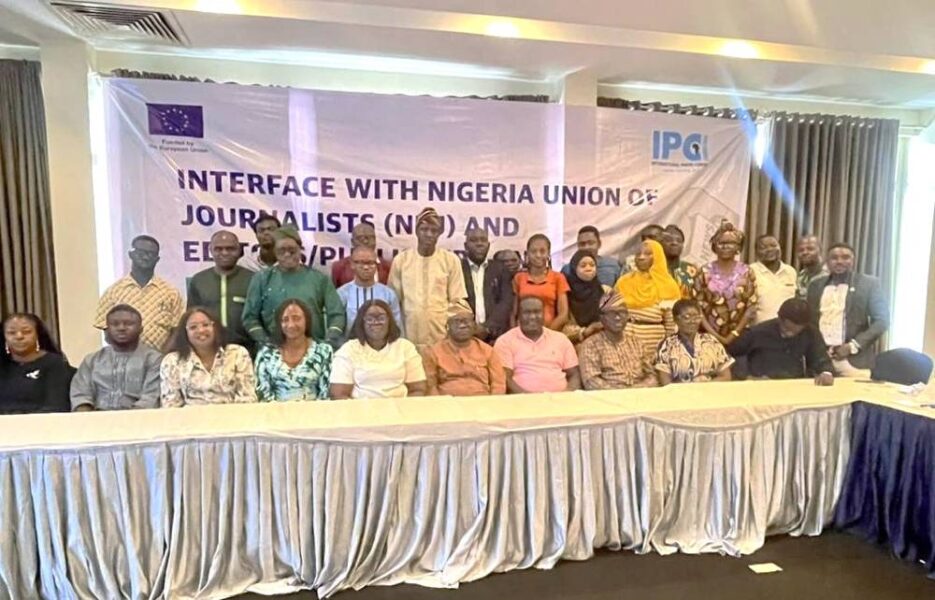
The charge was made at an interactive interface with members of the Nigeria Union of Journalists (NUJ), editors and publishers in Ibadan, organised by the International Press Centre (IPC) under Component 4, Support to Media, of the European Union Support to Democratic Governance in Nigeria (EU-SDGN III) programme.
The engagement focused on professional and democratic accountability journalism, with discussions centred on the responsibilities of the media as Nigeria moves towards another election cycle.
In his presentation, “2027 General Election in the Context of Democratic & Accountability Reporting: Scanning the Electoral Environment and Reporting Citizens’ Priority Concerns,” general editor of the Nigerian Tribune and media scholar, Taiwo Adisa, said the media had a major responsibility to help strengthen Nigeria’s democracy despite the growing disillusionment with democratic governance.
Adisa described the media as the “Fourth Estate” with responsibilities as auditors, gatekeepers and ombudsmen, arguing that journalists must hold those exercising public power to account.
He distinguished between professional accountability, which requires journalists to hold themselves to the ethics and standards of the profession, and democratic accountability, which requires journalism to scrutinise government, public officials, institutions and other powerful actors.
According to him, accountability journalism requires more than reproducing official statements. It involves investigative reporting, rigorous follow-ups, fact-checking and data-driven analysis, while journalists must remain sufficiently informed and equipped with evidence to question authorities.
2027 campaign coverage
Adisa challenged journalists to interrogate the relatively muted campaign activities of political parties despite the longer campaign window provided by the electoral framework.
He noted that the Independent National Electoral Commission (INEC) opened campaigns for presidential and National Assembly elections on August 19, 2026, while campaigns for governorship and state assembly elections commenced on September 9.
Yet, he observed that many parties were still struggling to constitute or inaugurate campaign committees, while full-scale governorship campaigns were yet to emerge across Oyo State.
He urged journalists to ask candidates and political parties why they were not engaging voters more extensively, unveiling their manifestoes and presenting alternative policy proposals.
Another area flagged for scrutiny was campaign financing. Adisa drew attention to the apparent decline in public fundraising activities and questioned how political campaigns were being financed.
He said the Electoral Act 2026 places presidential campaign expenditure at ₦10 billion and argued that the monetisation of elections poses a serious threat to democratic accountability.
Journalists, he said, must closely monitor campaign spending and help expose violations by providing evidence that could assist electoral authorities in enforcing the law.
Oyo voters’ priorities
Adisa also urged journalists to shift attention from politicians’ activities to the issues that matter to voters.
He identified development, education, agriculture, rural roads, security, healthcare, water, electricity and economic transformation among the major concerns that should shape election reporting in Oyo State.
He noted that education remains particularly important, citing the political resonance of the cancellation of the N3,000 education levy by Governor Seyi Makinde after he assumed office in 2019.
Agriculture, he added, remains a major comparative advantage for the state, while rural roads linking communities to urban centres, healthcare facilities across the state’s 351 wards and 33 local government areas, security and economic support also require sustained attention from candidates.
However, he identified what he described as a “missing link” in grassroots political engagement: monetisation.
According to him, voters sometimes demand immediate personal benefits, school fees, hospital bills and other short-term gifts from politicians instead of questioning candidates about legislation and policies capable of addressing community problems.
He challenged journalists to help redirect political conversations towards issues and policies that can produce lasting democratic dividends.
Fact-checking becomes essential
The session also placed strong emphasis on fact-checking as an essential component of election journalism.
Olusola Oludiran, an NDR/IPC fact-checker, told participants that the media’s responsibility extends beyond reporting what political actors say to verifying whether their claims are supported by evidence and examining their implications for citizens.
His presentation, “Integrating Fact-Checking for Democratic and Accountability Report,” warned that misinformation and disinformation could influence electoral decisions, suppress voters, delegitimise election results, trigger violence and erode confidence in democratic institutions.
Oludiran identified misinformation, disinformation and malinformation as major forms of information disorder and highlighted fabricated stories, manipulated images, deepfakes, misleading videos, recycled content, fake endorsements and falsified election results as potential threats during the 2027 electoral cycle.
He urged journalists to develop a habit of questioning information before publication, including asking who made a claim, what the person stands to gain or lose, why it was made, how prominent the source is and whether the claim is verifiable.
The verification process, he said, should include checking original sources, examining reliable data, defining the relevant timeframe and context, consulting experts, presenting evidence and allowing claim-makers to respond.
Oludiran also demonstrated the growing challenge posed by artificial intelligence, including deepfake videos, cloned voices, fabricated news reports and synthetic images.
He stressed that no verification tool is completely accurate and that journalists must combine technology with human judgment, context and reliable sourcing.
The toolkit presented included Google Lens, reverse image search, InVID, TinEye, Deepware and other verification tools.
In the welcome remarks delivered on behalf of Lanre Arogundade, its Executive Director, the IPC said the effectiveness of the engagement would ultimately be measured not by the discussions alone but by the stories journalists publish, claims they verify, citizens whose concerns they amplify, accountability questions they ask and professional standards they uphold before the 2027 elections.
The centre stressed that responsible electoral journalism must prioritise accuracy, fairness, verification, conflict-sensitive reporting and accountability while giving meaningful visibility to women, young people, persons with disabilities and other under-represented groups.