
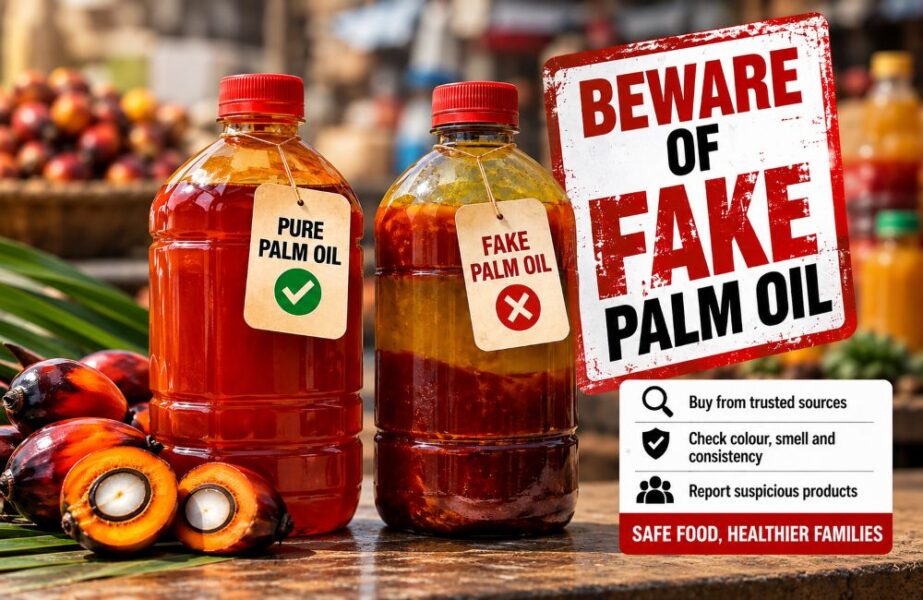

Lagos residents have been warned against relying on the deep-red colour of palm oil as evidence of quality, amid emerging methods of adulteration that may be difficult to detect through ordinary visual checks.
The Lagos State Consumer Protection Agency (LASCOPA) issued the warning as it announced plans to intensify market surveillance across the state to curb the sale of unsafe and substandard food products.
Warning came during the 2026 Lagos State Food Safety Conference and Exhibition, where Nurah Oseni, a senior lecturer in the Department of Food Technology at Auchi Polytechnic, presented a paper titled, ‘Palm Oil Adulteration: Emerging Risks, Detection Strategies and Regulatory Control.’
According to a statement shared by the Lagos State Government on Monday, Oseni said palm oil was particularly vulnerable to adulteration because of its high trading volume, price differences, informal market practices and consumers’ tendency to associate deep-red colour with quality.
She also noted that advances in adulteration techniques were making it increasingly difficult for consumers to identify contaminated palm oil through basic checks.
Among the emerging risks she highlighted was the use of potentially carcinogenic Sudan and Azo dyes to alter the colour of palm oil.
The concerns come against a broader backdrop of food safety challenges in Nigeria, with the National Agency for Food and Drug Administration and Control (NAFDAC) also raising concerns about the adulteration of palm oil with hazardous substances, including azo dyes, particularly in unbranded products sold in open markets.
Oseni further identified the blending of palm oil with recovered or recycled oils, including spent cooking oil, as another potential adulteration practice.
She warned that some adulterators could combine multiple substances in ways designed to evade basic quality checks.
Falsified product labels and batch records were also identified as a concern because they could make it difficult for regulators to trace contaminated products through the supply chain.
How consumers can identify adulterated palm oil
Oseni advised consumers to conduct visual checks as an initial precaution when purchasing palm oil but stressed that appearance alone could not establish whether the product was safe.
She explained that palm oil could naturally separate into layers, with the lower portion typically appearing orange to red-yellowish rather than uniformly deep red.
According to her, consumers should therefore not assume that a uniformly deep-red colour automatically indicates good quality or that a different appearance necessarily means the product is adulterated.
For more reliable detection, she recommended a tiered testing approach involving risk-based screening, rapid physicochemical and spectroscopic tests, followed by confirmatory laboratory analysis.
She said the process should also be backed by proper sampling and chain-of-custody procedures to ensure that samples can be reliably traced from collection to laboratory testing.
Oseni proposed a five-step surveillance framework for Lagos built around “Risk Map, Sample, Screen, Confirm and Act.”
She said the framework should be supported by an adulteration intelligence database and clearly defined responsibilities for processors, traders, laboratories, regulators, researchers and consumers.
LASCOPA promises stronger market surveillance
LASCOPA General Manager and Chief Executive Officer, Afolabi Solebo, reaffirmed the agency’s commitment to protecting Lagos consumers from unsafe and substandard products.
Solebo urged residents to report suspected cases of palm oil adulteration and traders believed to be engaging in deceptive practices through LASCOPA’s official channels.
“We urge Lagosians to shine their eyes and report suspected adulterated palm oil and unscrupulous traders through the Agency’s official channels,” he said.
He added that LASCOPA would intensify market surveillance across Lagos as part of efforts to protect consumers and strengthen food safety enforcement.