
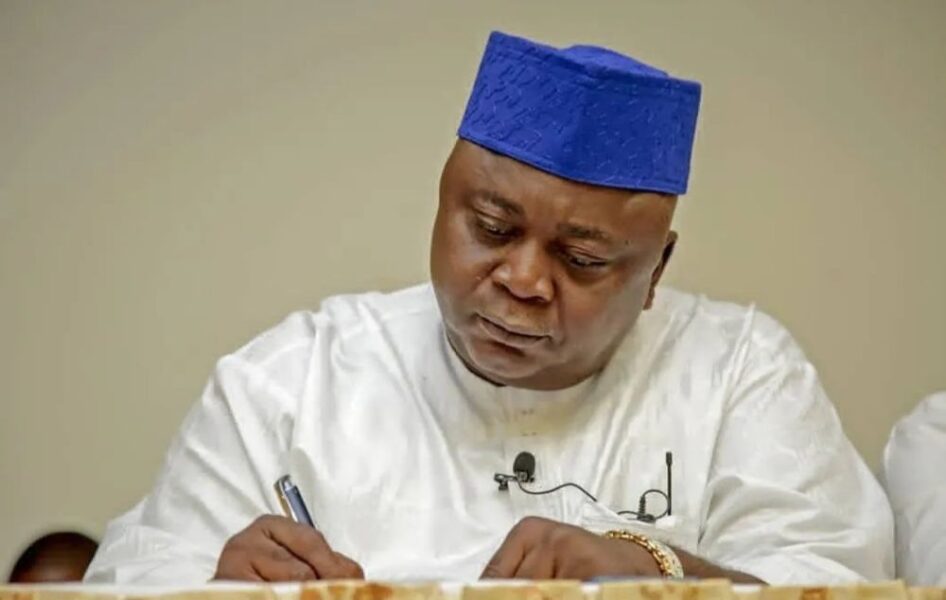

The Independent National Electoral Commission (INEC) has approached the Court of Appeal to challenge a Federal High Court judgment ordering it to recognise Ladi Adebutu as the Peoples Democratic Party (PDP) governorship candidate for the 2027 Ogun State election.
INEC filed its notice of appeal on Wednesday, November 25, 2026, seeking a review of the judgment delivered by Justice Peter Lifu of the Federal High Court, Abuja, on November 13.
Justice Lifu had directed the electoral commission to reinstate Adebutu’s name on the list of candidates for the forthcoming governorship election, holding that INEC lacked the authority to unilaterally disqualify a candidate validly nominated by a political party.
The judge also ruled that the commission breached Adebutu’s right to fair hearing by excluding his name without allowing him to respond.
He consequently declared the exclusion unlawful, unconstitutional and of no effect, ordering INEC to rectify its October 10 candidates’ list to reflect Adebutu’s name.
However, the judgment has attracted legal and political criticism, particularly over the interpretation of Section 77 of the Electoral Act 2026 and its implications for political parties seeking to sponsor candidates in elections.
A former member of the House of Representatives and Chairman of the Planning Committee of the Ogun State APC Presidential and Gubernatorial Campaign Council, Kayode Oladele, had earlier questioned the legal foundation of the ruling.
Oladele, who is also a lawyer, raised concerns about the court’s reliance on the Supreme Court judgment in the case involving INEC and the Zenith Labour Party.
He argued that the court appeared to have confused the constitutional qualification of an individual seeking elective office with the statutory obligations political parties must fulfil before sponsoring candidates.
According to him, the central question was not whether Adebutu possessed the constitutional qualifications to contest the governorship election, but whether the PDP complied with the mandatory provisions of the Electoral Act in sponsoring his candidacy.
Oladele maintained that since the Nigerian Constitution does not provide for independent candidacy, an individual’s constitutional eligibility cannot override a statutory disability arising from the sponsoring political party’s failure to comply with electoral requirements.
He also questioned the competence of Adebutu’s suit, arguing that it was statute-barred under the constitutional provisions prescribing the timeframe for instituting pre-election matters.
Another contentious issue concerns the membership register submitted by the PDP to INEC and the legal implications of the Supreme Court’s decision upholding the relevant provisions of the Electoral Act 2026.
Section 77(5)–(7) of the Electoral Act 2026 establishes requirements for political parties to submit their membership registers to INEC.
The Supreme Court had earlier upheld the constitutionality of the relevant provisions in a dispute involving the Zenith Labour Party and the electoral commission.
INEC had previously maintained that Adebutu’s name was missing from the PDP membership register submitted to the commission, a position that formed part of the dispute before the Federal High Court.