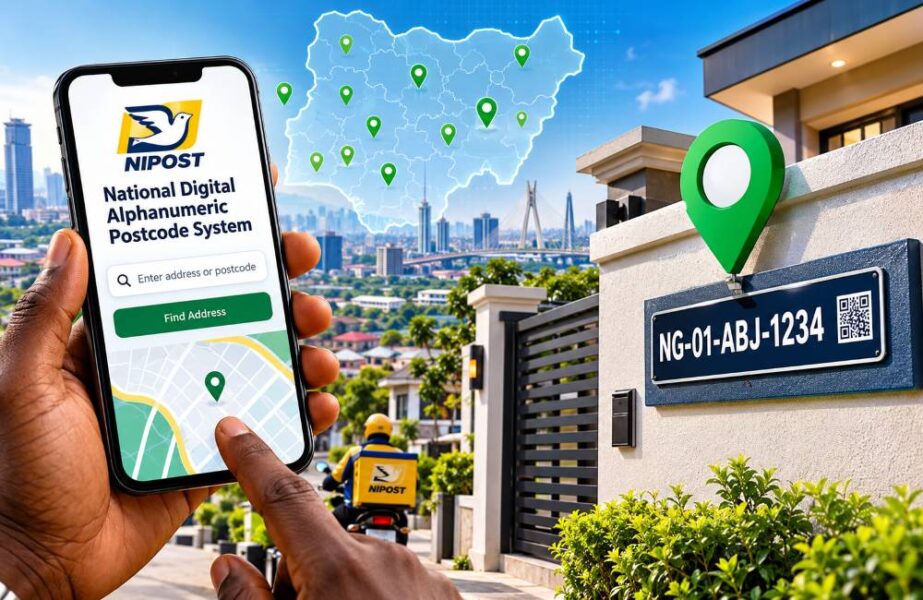

The Federal Government has officially launched Nigeria’s National Digital Alphanumeric Postcode System, giving addressable buildings across the country a unique digital location reference.
Launched on Thursday, October 1, 2026, through the Nigeria Postal Service (NIPOST), the new system is designed to make it easier to identify, locate and share specific buildings using an 11-character alphanumeric code.
The launch marks a shift from Nigeria’s existing six-digit postcode system, which generally identifies broader geographical areas, to a digital system designed to pinpoint individual buildings.
For Nigerians who want to find out whether their homes, offices or business premises already have a digital postcode, the process can be completed online through the official NIPOST Digital Postcode platform at postcode.gov.ng.
Official NIPOST Digital Postcode platform
How to find your digital postcode
To find the postcode assigned to your building, visit the official Digital Postcode platform at postcode.gov.ng.
The platform allows users to search for a building or location. Users can search using their address or place, or allow the system to use their current location to identify the building.
Once the correct building is identified, its 11-character digital postcode will be displayed.
Users should ensure they have selected the correct building before saving or sharing the code.
NIPOST says the postcode belongs to the building, not the individual.
This means people living or working in the same building can use the same postcode, while someone who moves to another building will use the postcode assigned to the new location.
What if your building has no digital postcode?
Some buildings may not yet have a postcode as the nationwide system is rolled out.
If a search shows that no postcode has been assigned to the building, users can request one directly through the Digital Postcode platform or app.
According to NIPOST, the request process allows users to provide their address and building information, with options to provide additional details and photographs where necessary.
After reviewing the information, NIPOST will process the request and assign an official postcode if the application is approved.
Users are advised not to create, guess or use another building’s postcode.
How to save your digital postcode
Once a postcode has been found, users can save it through the Digital Postcode application.
This is particularly useful for locations that are frequently used, such as a home, office, shop or other business premises.
Saved postcodes can be retrieved later without having to search for the location again.
How to share your digital postcode
NIPOST also allows users to share their digital postcode with other people.
After finding the correct building in the application, users can select the Share option and send the postcode through available sharing applications.
The code can be shared with family members, friends, customers, delivery companies or anyone who needs a standard reference for the location.
Users can also copy the postcode and paste it into a message or form.
Does the digital postcode replace your address?
No.
The new digital postcode is designed to work alongside an existing physical address rather than replace it.
Users can continue providing details such as their house number, street, town and local government area while adding the 11-character digital postcode as a standard reference for the building.
NIPOST also says the digital postcode does not replace navigation services such as Google Maps.
Instead, it provides a standardised way of identifying the building, while mapping applications can still be used to provide directions.
What is the 11-character postcode made of?
The new system uses a hierarchy covering state, local government area, district, area and building.
According to the official platform, the first part identifies the state, followed by codes representing progressively smaller geographical areas until the building level is reached.
This allows the system to provide a precise digital reference for an individual addressable building rather than simply identifying a wider postal area.
Is the digital postcode free?
Yes.
NIPOST says individuals can find, save and share their digital postcodes for free through the official Digital Postcode website and application.
Businesses and government organisations can also use the system for activities such as delivery operations, customer-location verification, asset management and service delivery, with organisations able to register their interest in integrating the system into their platforms.
Why the Federal Government introduced the system
Government officials say the new system is intended to address longstanding challenges associated with identifying and locating addresses in Nigeria.
Poor addressing has implications for deliveries, e-commerce, emergency response, security, financial services and public-service delivery.
The Federal Government has said the new system is expected to improve these areas by providing a common digital reference for physical locations.
For ordinary Nigerians, one of the immediate benefits is the ability to provide a standard digital reference for a building instead of relying entirely on lengthy directions, landmarks or repeated phone calls to explain how to locate an address.
What Nigerians should do now
With the National Digital Alphanumeric Postcode System officially launched nationwide on October 1, Nigerians can check whether their homes and business premises have already been assigned a digital postcode.
Visit postcode.gov.ng, search for the building and confirm that the location displayed is correct.
If no postcode has been assigned, use the platform’s postcode request option rather than creating or guessing a code.
Once obtained, the postcode can be saved and shared whenever a precise digital reference for the building is required.
Official platform: postcode.gov.ng — NIPOST Digital Postcode