
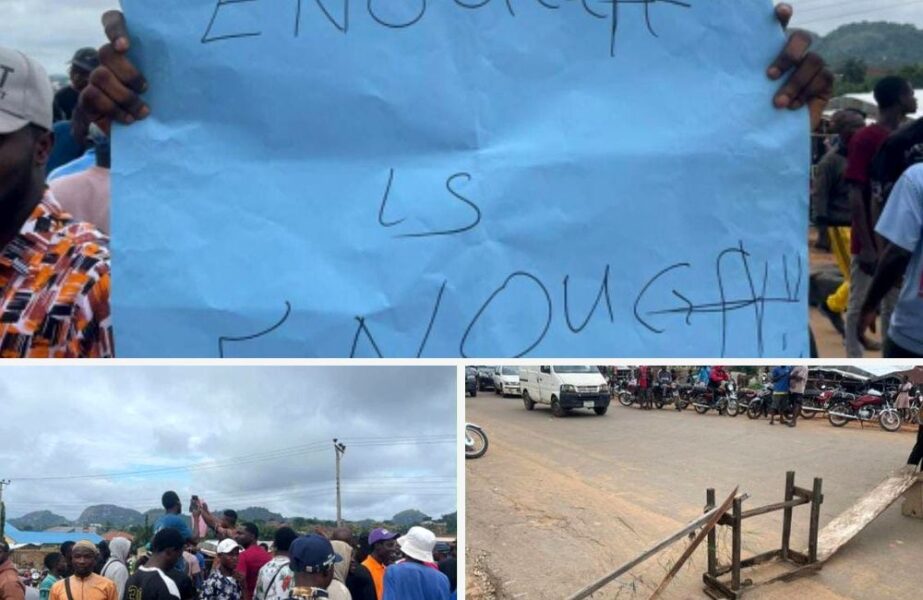

Students of Adekunle Ajasin University, Akungba-Akoko, Ondo State, on Thursday barricaded major roads around the institution, demanding an immediate resolution of the prolonged industrial action that has kept them away from campus for about 68 days.
The protest, led by the Students’ Union Government, caused hardship for travellers as the students blocked the university’s main gate and some roads linking the institution to the major highway.
The protesters, who carried placards with inscriptions including, “Every pending graduate, shey na our lives be these?”, “NASU, NAAT, SSANU have joined strike” and “Enough is Enough”, called on the Ondo State Government, led by Governor Lucky Aiyedatiwa, to urgently intervene in the crisis.
The students said the prolonged closure had created uncertainty for undergraduates, particularly those awaiting graduation examinations.
Speaking with journalists at the protest ground, the SUG President, Folagbade Greatness Ayoola, said the students had exhausted their patience after repeated promises of a resolution.
Ayoola said the situation had become particularly difficult for students who continued to pay school fees while lecturers were allegedly owed salaries.
He said, “We cannot keep silent because we are really facing challenges in our university. Imagine students having to pay school fees while lecturers’ salaries are not being paid. ASUU had demands before the government, but after a series of meetings and the failure to get the necessary response, the union embarked on an indefinite strike.”
The SUG president said students had continued to hear assurances that the issues would be resolved, but without a concrete outcome.
“We keep hearing promises and pushing for a solution, but nothing concrete has happened. At this point, we have no other option than to come out and make our voices heard,” he said.
Ayoola vowed that the students would continue to pursue legitimate means of pressing their demands until the strike was called off.
Also speaking, the Students’ Union General Secretary, Oluwatimileyin Amos, said the prolonged absence from school was placing students in a difficult situation.
Amos said students had spent about 68 days at home without knowing when academic activities would resume.
“We have been on strike for 68 days now and something needs to be done. We need an immediate resolution and action because our students are suffering. This is an injury to one and an injury to all, so we are calling on students to solidarise with us and let our voices be heard,” he said.
According to him, the uncertainty was particularly affecting students who were approaching their final examinations.
“Students are in a dilemma. They do not know whether to travel or stay back. This has caused a lot of hardship for students, especially the pending graduates whose examinations are approaching. We need the strike to be called off with immediate resolution,” Amos added.
The Students’ Senate President, Adebiyi Kehinde, said the union had previously engaged the university management and other stakeholders in an effort to resolve the dispute.
Kehinde said those engagements had yet to produce the desired result.
“For almost 60 days now, we have been at home. We have tried our best by engaging the management and important stakeholders who we believe can intervene and ensure that the strike is called off,” he said.
He appealed to the state government to take the necessary steps to resolve the issues behind the industrial action and allow students to return to their academic activities.
“We are not asking for too much. We just want to resume and continue our academic activities. We urge the government to do the needful and end this strike,” Kehinde said.
He also appealed to the students to remain peaceful while supporting the union’s efforts to secure a resolution.
A 500-level student, Ogungbade James, equally called on the government to resolve the outstanding issues and meet its obligations to create the conditions necessary for students to return to campus.
The protest comes amid growing concern among students over the effect of the prolonged industrial action on their academic programmes and graduation timelines.