
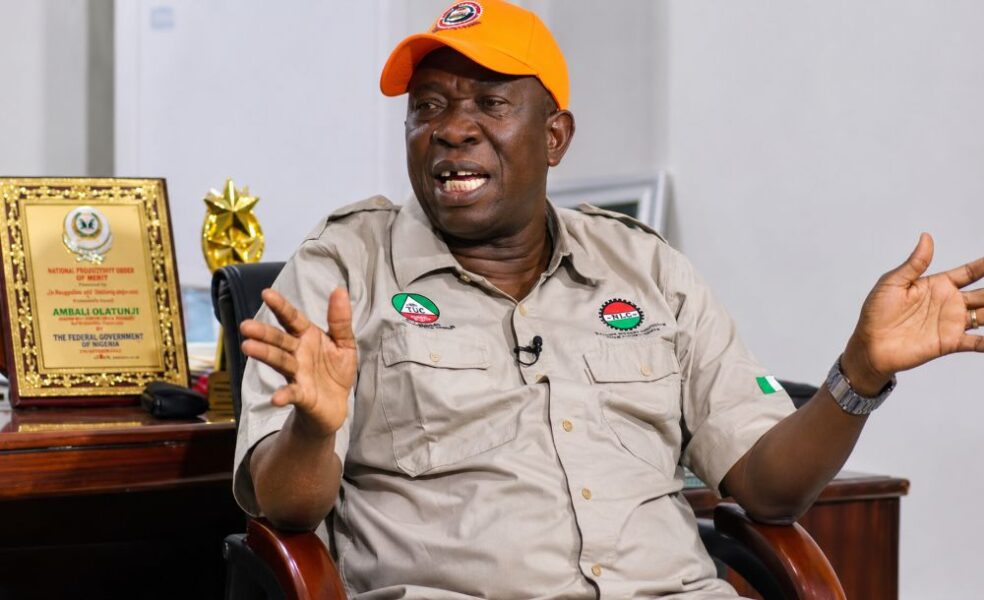

Former National President of the Nigeria Union of Local Government Employees (NULGE), Akeem Ambali, has warned that the growing rift between the Nigeria Labour Congress (NLC) and the Trade Union Congress (TUC) could weaken organised labour’s ability to protect workers’ interests.
Ambali, a former NLC Treasurer and Ogun State chairman, spoke on Tuesday during an interview on Frontline, a current affairs programme on Eagle 102.5 FM, Ilese-Ijebu, Ogun State.
He said the disagreement over the Federal Government’s proposed ₦70,000 transport allowance was an unnecessary distraction when workers were already battling inflation, declining purchasing power and rising transportation and energy costs.
The dispute intensified after NLC President Joe Ajaero signed a Memorandum of Understanding with the Federal Government without the participation of TUC President Festus Osifo, who rejected the arrangement, saying his congress was not carried along.
Ambali said organised labour should instead focus on better wages, minimum pensions, healthcare and affordable social services.
He noted that fuel subsidy removal, inflation and the floating of the naira had severely reduced workers’ real incomes, while rising transport and electricity costs were putting additional pressure on households.
According to him, weakened purchasing power also hurts local businesses because workers’ salaries circulate largely within domestic markets.
On the ₦70,000 allowance dispute, Ambali said both labour centres had historically participated in negotiations affecting workers generally.
He recalled that NLC, TUC and the Joint Negotiating Council were represented during the 2024 minimum wage negotiations.
He faulted the NLC for failing to properly brief the TUC before reaching the latest agreement, but also acknowledged the TUC’s concern over the government’s record of implementing previous agreements.
Ambali said TUC’s apprehension was understandable, citing the government’s failure to fully implement the previous ₦30,000 wage award and questioning what guarantees existed for the new allowance.
However, he cautioned against rejecting the ₦70,000 payment, arguing that workers should accept whatever immediate relief was available while continuing to demand better remuneration.
He nevertheless described the allowance as inadequate, noting that it amounts to slightly more than ₦2,000 daily and cannot substantially address current living and transportation costs.
Looking ahead, Ambali urged NLC and TUC to begin preparations for the next national minimum wage negotiations, expected to commence in April.
He advised the unions to engage economists, academics and other experts to develop evidence-based demands before negotiations begin.
Ambali proposed a minimum wage of ₦400,000, arguing that workers’ earnings must reflect rising costs of transportation, housing, energy and other essentials.
He also urged labour to ensure national agreements are implemented by state governments and private employers.
Drawing from his experience as Ogun NLC chairman, he recalled a previous dispute in which he suspended a planned strike after his TUC counterpart reached a separate understanding with government.
He said he subsequently informed the TUC before proceeding independently, stressing that labour centres must maintain communication even when they disagree.
Ambali called for a review of Nigeria’s labour laws to provide clearer rules for negotiations involving workers represented by multiple labour centres.
He argued that any agreement affecting workers generally should involve all recognised labour organisations rather than excluding any of them.