
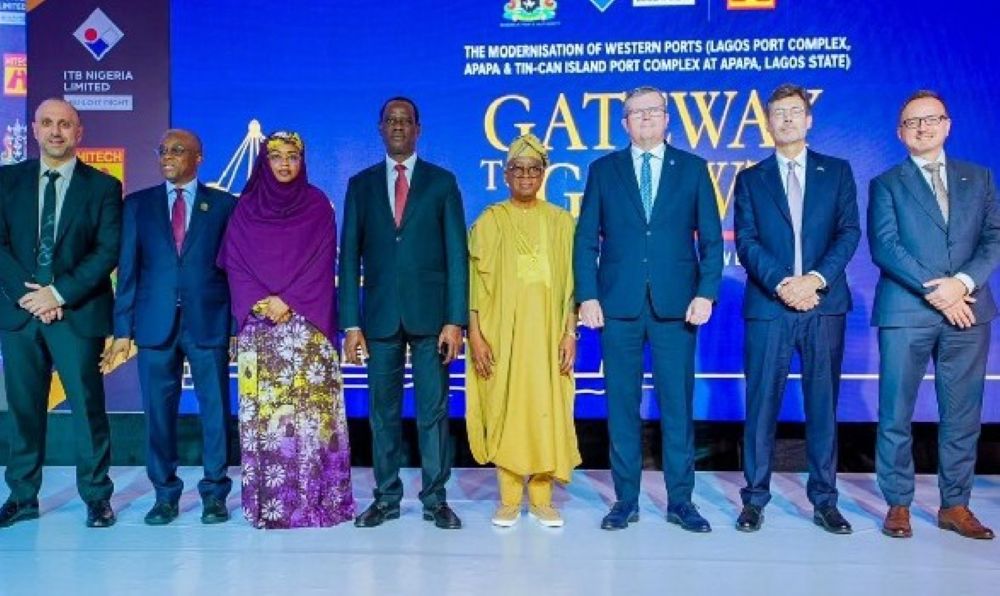

Federal Government has commenced a £746 million (approximately ₦1.45 trillion) modernisation of the Apapa and Tin Can Island ports in Lagos, in a major intervention aimed at reducing cargo delays, cutting logistics costs and strengthening Nigeria’s position in international maritime trade.
Minister of Marine and Blue Economy, Adegboyega Oyetola, performed the groundbreaking ceremony at Tin Can Island Port on Wednesday, November 25, alongside the Minister of Finance and Coordinating Minister of the Economy, Taiwo Oyedele, and other senior government officials.
The project is expected to generate at least 20,000 direct and indirect jobs across construction, engineering, dredging, logistics, transportation and port operations.
Oyetola said the investment had become necessary because the country’s ageing port infrastructure could no longer adequately support the expansion of Nigeria’s economy and growing international trade activities.
He disclosed that inefficiencies at Nigerian ports had historically pushed cargo dwell time to between 10 and 18 days, compared with three to five days at leading international ports, costing the economy an estimated $4 billion annually.
The minister warned that Nigeria risked losing more maritime business to neighbouring countries that had invested heavily in modern port infrastructure and cargo-handling facilities.
“The cost of inaction is far greater than the cost of modernisation,” Oyetola said, insisting that Nigeria could not afford to surrender its competitive advantage in regional and international trade.
He said the government’s ambition was to attract more direct calls by international shipping lines, retain Nigerian-bound cargo, expand transshipment opportunities and establish the country’s ports as preferred gateways for trade across the African Continental Free Trade Area (AfCFTA).
Why the Lagos ports need modernisation
Oyetola highlighted the widening gap between Nigeria’s economic growth and the capacity of its existing port facilities.
According to him, Apapa Port was established in 1913, making it more than a century old, while Tin Can Island Port was commissioned in 1977 when Nigeria’s population was approximately 67.2 million.
At the time, the country’s annual merchandise trade stood at about $17 billion, while cargo throughput was 8.11 million metric tonnes.
Nigeria’s population has since increased to approximately 240 million, annual merchandise trade has exceeded $100 billion, and cargo throughput has risen to 129.3 million metric tonnes, representing nearly a 16-fold increase since 1977.
The minister said the pressure on existing facilities had made comprehensive rehabilitation unavoidable.
The modernisation programme will cover quay walls and berths, dredging and navigation channels, access facilities, cargo-handling equipment and operational systems. It will also introduce more integrated and digitally enabled port operations.
Project financing and international partnership
The financing arrangement is also significant for Nigeria’s international economic relations.
Oyedele described the transaction as Nigeria’s largest sovereign export credit transaction since 2009 and the first Nigerian project for Poland’s Export Credit Insurance Corporation, KUKE.
The £746 million financing is backed by the United Kingdom’s Export Finance (UKEF), with Citibank coordinating and arranging the facility. Poland’s KUKE is also participating through a reinsurance arrangement covering almost half of the financing.
Under the agreement announced in March 2026, at least £236 million of supplier contracts will go to British companies.
British Steel is expected to supply 120,000 tonnes of steel billets under a £70 million contract to construction firms Hitech Nigeria and ITB Nigeria.
Oyedele said improved port operations would lower the cost of doing business, reduce delays for importers and exporters and improve the competitiveness of Nigerian products.
He reaffirmed the Federal Government’s commitment to timely approvals, transparency and a stable operating environment throughout the project’s implementation.
FG moves to prevent disruption during construction
Oyetola disclosed that he had approved an Inter-Ministerial Committee comprising the Federal Ministry of Marine and Blue Economy, the Nigerian Ports Authority (NPA) and the Nigeria Ports Economic Regulatory Agency to develop a Port Business Continuity and Cargo Flow Management Plan.
The committee will coordinate phased construction, vessel scheduling, cargo evacuation, truck traffic management and the possible use of alternative ports and transportation channels to minimise disruptions to commercial activities.
He said the arrangement would ensure that businesses relying on the two Lagos ports could continue operating while construction progresses.
Beyond Lagos, Oyetola said the modernisation programme formed part of a broader national maritime transformation agenda covering the approved upgrades of Onne Port in Rivers State, Delta Port and Calabar Port in Cross River State.
Also speaking at the ceremony, NPA Managing Director, Abubakar Dantsoho, described the groundbreaking as a landmark development in the authority’s history.
He pledged that the agency would ensure the project was executed in line with approved designs, engineering standards and contractual timelines.
Dantsoho also promised effective technical supervision, quality assurance and coordination, with particular attention to safety, environmental standards and uninterrupted port operations.
The ceremony attracted Poland’s Deputy Foreign Minister, Marcin Bosacki; Polish Ambassador to Nigeria, Michal Cygan; and British Deputy High Commissioner in Lagos, Jonny Baxter, alongside contractors, international financing partners and other stakeholders in the maritime industry.