
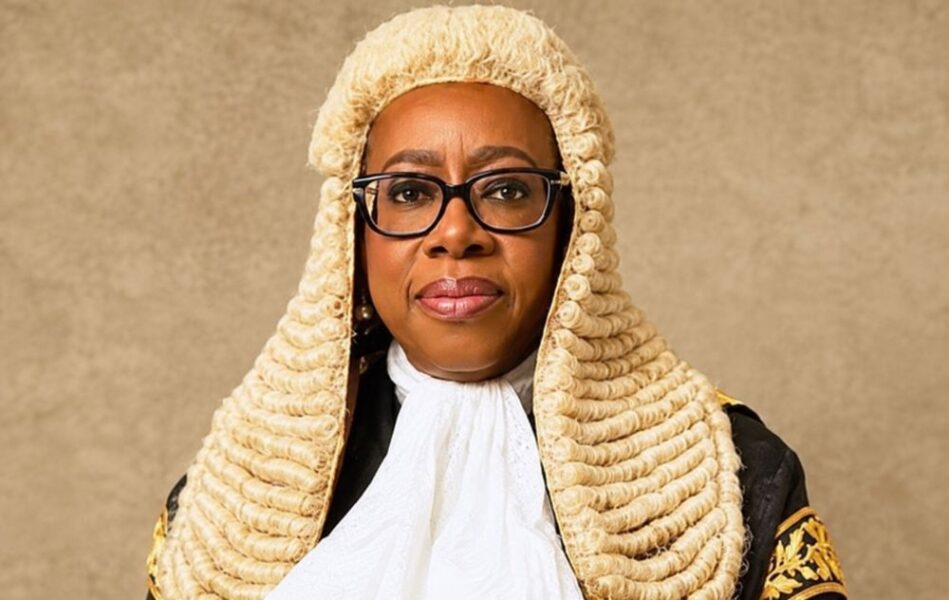

Chief Justice of Nigeria, Justice Kudirat Kekere-Ekun, has charged 12 newly appointed Justices of the Court of Appeal to protect judicial independence, uphold integrity and resist political, financial, social and personal pressures.
Kekere-Ekun gave the charge on Tuesday at the swearing-in ceremony of the new appellate court justices at the Supreme Court complex in Abuja, stressing that their elevation came with greater responsibilities for the administration of justice and the development of Nigerian jurisprudence.
She urged the justices to combine collective decision-making with individual judicial independence, noting that their new roles would require them to work in panels rather than exercise judicial authority as sole presiding judges.
According to the CJN, the new justices must be prepared to engage with the views of their colleagues, test their initial conclusions and reconsider their positions where convincing legal arguments are presented.
However, she warned that collegiality must not result in the abandonment of personal judicial convictions.
“Where, after careful consideration, your view differs from that of the majority, you must have the courage to maintain and express it with clarity, restraint and respect,” she said.
Kekere-Ekun described well-reasoned dissenting judgments as a legitimate feature of appellate adjudication, noting that such opinions could contribute to the development or reconsideration of the law.
She also reminded the new justices that decisions of the Court of Appeal have far-reaching consequences, providing guidance to lower courts, legal practitioners, public institutions and citizens.
The CJN therefore urged them to approach appeals with discipline and avoid treating appellate proceedings as opportunities to rehear cases simply because they might have reached a different conclusion from a lower court.
“An appeal is not an invitation to rehear a case simply because another judicial officer might have reached a different conclusion,” she said.
She advised the justices to carefully examine records of proceedings, findings of lower courts and properly raised grounds of appeal before deciding whether there are sufficient legal grounds for intervention.
Kekere-Ekun further cautioned against disturbing findings of fact without adequate justification, particularly in circumstances where an appellate court did not have the opportunity to observe witnesses directly.
On judicial independence, she urged the appointees to guard against influences arising from political interests, financial considerations, social relationships, professional familiarity and personal connections.
“Your judicial independence must be guarded against political, financial, social and personal pressures, including those that may arise through professional familiarity or established relationships,” she said.
The CJN also stressed the importance of continuous judicial education as the legal landscape evolves.
She identified digital commerce, data protection, intellectual property, financial regulation and labour relations among emerging areas requiring greater judicial knowledge.
Kekere-Ekun also addressed the growing role of artificial intelligence in legal research and information management, advising the new justices to use technology with caution and discernment.
She said technology could assist with legal research and the organisation of judicial work but insisted that legal authorities must be independently verified and judicial decisions must remain the product of judges’ considered judgment.
Nigeria’s number one judicial officer further reminded the appointees that confidentiality and the ethical obligations of judicial office must be preserved, while their conduct outside the courtroom must reflect the dignity of their positions.
“Integrity must be evident not only in the judgments you deliver but also in your daily choices, professional relationships and exercise of judicial authority,” she said.
The 12 new Justices of the Court of Appeal are Yakubu Abdulhammeed Mohammed, Monisola Oluwatoyin Abodunde, Raphael Ajuwa, Elias Ojie Abua, Mbalamen Jennifer Ijohor, Sabiu Bala Shuaibu, James Kolawole Omotosho, Emeka Nwite, Dauda Njane Buba, Sanusi Kado, Enikuomehin Ademola and Julcit Veronica Dadom.
They were drawn from the High Courts of Gombe, Bayelsa, Cross River, Benue, Kebbi, Taraba and Ondo states, as well as the Federal High Court, National Industrial Court of Nigeria and Customary Courts of Appeal of Ekiti and Plateau states.
Their appointments followed recommendations by the National Judicial Council at its 111th meeting held in May 2026.
The council said the appointments were intended to fill vacancies created by the elevation and retirement of judicial officers and strengthen the capacity of the courts to deliver justice.