

By Kunle Kalejaye
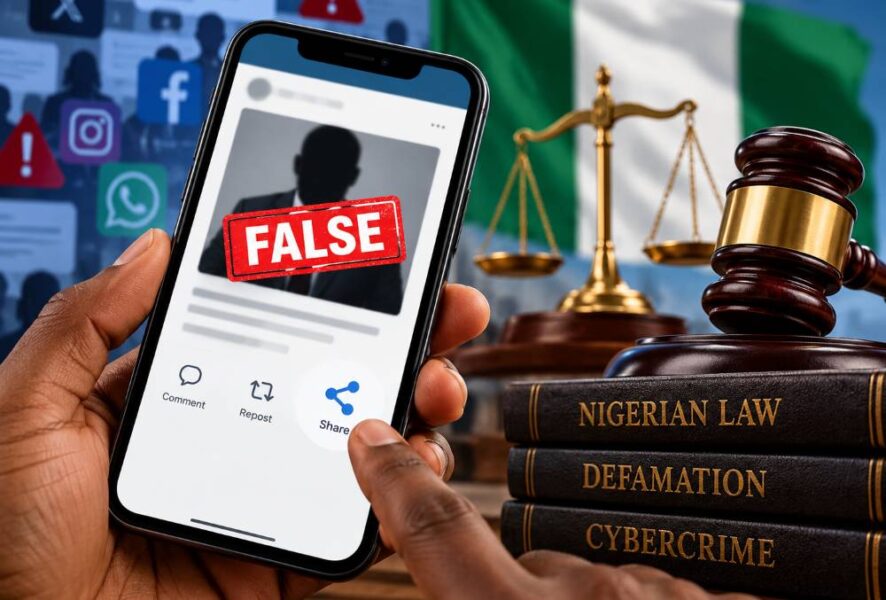
The digital age has turned anyone with a smartphone and an internet connection into a publisher. This power comes with immense legal responsibility. A reality many Nigerian internet and smartphone users ignore or are not aware of until it is too late. A recent example involves the wave of sensational accusations targeted at a top gospel singer. As viral rumors flooded timelines, thousands of users eagerly retweeted, reposted, and forwarded defamatory content without thinking of its legal implications. Others, seeking to make content, made voice-overs, thus repeating and amplifying the contentious allegations. In doing so, many operated under the dangerous illusion of immunity, believing they were merely “sharing” news rather than creating it.
In defamation law, this misconception is most certainly a very costly mistake. Under Nigerian jurisprudence, anyone who repeats or shares a defamatory statement is just as legally liable as the person who first originated it.
Under Nigerian civil law, defamation is a serious wrong designed to balance free speech with the constitutional right to human dignity. A common myth among social media users is that adding a disclaimer like “Forwarded as received” or “Allegedly” or “# shared” insulates them from legal consequences. Dead wrong! It does not. Nigerian courts strictly apply the doctrine of secondary publication, treating each share or retweet as a fresh, independent publication. As reiterated in the case of DTN PLC v. ARUM(2021): every repetition of a defamatory statement gives the victim a new reason to sue. The person who shares a malicious post cannot escape liability by claiming they were not the author; they have actively widened the circle of harm, destruction, and misery.
When false allegations spread online, they constitute libel because they are cast in a permanent digital form. All the aggrieved party needs to prove is that the statement was false, referenced them, and was published to a third party; a requirement that a simple retweet satisfies. That a publication was made online carries far-reaching implications: universal accessibility with minimum protocols.
Nigerian courts do not treat digital defamation lightly. High-profile suits have seen courts award massive sums in damages, sometimes exceeding ₦100 million, against individuals who spread falsehoods. Furthermore, the rule governing digital jurisdiction means an online publication occurs anywhere the content is downloaded or read. If you share a defamatory post in Lagos and it is read in Abuja, the victim can legally force you to defend an expensive lawsuit in an Abuja court. In the DTN PLC case referenced above, the Court of Appeal of Nigeria applied a decision of the British Court of Appeal which approved that a British court has jurisdiction over a libel contained in an online publication made in California, USA, which was downloaded and read in the UK. A distance of about 8560 kilometres!
Beyond civil remedies, sharing defamatory material triggers severe statutory criminal liabilities across Nigeria’s regional legal codes. In Southern Nigeria, Section 373 of the Criminal Code Act explicitly defines defamatory matter as anything likely to injure a person’s reputation by exposing them to hatred, contempt, or ridicule. Under Section 375, simply publishing this material is a misdemeanor carrying up to one year of imprisonment, which escalates to two years of imprisonment if the sharer knew the statement was false. Conversely, in Northern Nigeria, Section 391 of the Penal Code Act criminalises any imputation made or published via mechanical reproduction or visible representation with the intent or knowledge that it will harm a reputation. Under Section 392, violators face up to two years of imprisonment, a fine, or both. Crucially, under Section 393, printing, engraving, or selling such material carries even steeper penalties of up to five to ten years behind bars.
This core criminal framework operates in tandem with federal legislation. The Cybercrimes (Prohibition, Prevention, etc.) Act regulates digital behavior and was significantly overhauled by the Cybercrimes (Amendment) Act 2024. This amendment reformed the controversial Section 24 (Cyberstalking), which law enforcement previously weaponised to arrest citizens for content that merely caused “annoyance” or “insult”. Following a restrictive ruling by the ECOWAS Court of Justice, the 2024 revision stripped out these vague terms. It now narrowly criminalises spreading false information explicitly intended to threaten life, cause intimidation, or provoke public disorder, carrying penalties of up to a ₦7,000,000 fine and three years’ imprisonment. Section 19 also criminalises intentionally publishing misleading information to deceive the public, carrying up to two years’ imprisonment.
The frenzy surrounding the accusations against the top artiste serves as a stark warning. Social media gives everyone a loud voice, but it also binds us to the same legal standards as traditional pen and paper writers.
Before sharing a scandalous claim, you must ask yourself: Is this verified? Do I have proof? Am I ready to face criminal prosecution under criminal laws, spend time in prison or hire a lawyer to defend this in a Magistrate or High Court? If the answer is no, let the rumor end with you. A single tap of the share icon is all it takes to turn a bystander into a criminally liable defamer with also a civil damnification in heavy damages that can gulp all your life’s savings and possibly make you down-and-out!
Asiwaju Kalejaye (SAN) is the founder and chairman of Eagle102.5 FM, Ilese-Ijebu