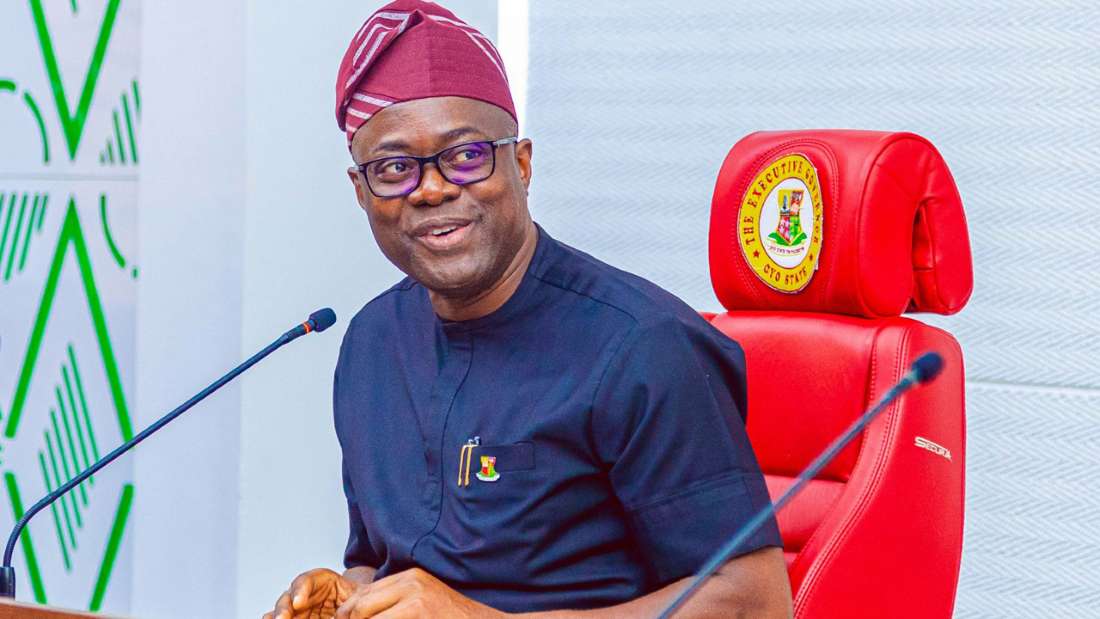
Oyo State Governor Seyi Makinde has challenged the Federal Government to publish its petroleum pricing template, demanding transparency over how fuel prices are determined amid rising costs and the introduction of a temporary petrol discount.
Makinde, also the Allied Peoples Movement (APM) presidential candidate for the 2027 general election, made the demand on Saturday at the party’s North-East 2027 Town Hall Meeting in Yola, Adamawa State.
He said Nigerians should be allowed to examine the figures and calculations behind the government’s petroleum pricing decisions and offer alternative solutions where necessary.
The governor’s demand followed the Federal Government’s announcement of a 30-day petrol discount at Nigerian National Petroleum Company Limited (NNPCL) retail outlets, alongside plans to introduce a price-modulation mechanism to manage fluctuations in fuel prices.
Speaking at the gathering, Makinde said the government should make its pricing calculations public rather than rely on explanations that do not provide sufficient details.
“Just release to Nigerians your pricing template: how you arrived at your figure, and let Nigerians – they are not dumb – look at your pricing templates, and if they have a better solution, they will present it,” he said.
Makinde added that occupying public office did not mean government officials had a monopoly on knowledge or solutions to the country’s economic challenges.
“The fact that we’re in government or you’re in the Presidential Villa does not make you the only people with sense. In Nigeria, we have Nigerians who can dissect issues and proffer solutions. So please give us your pricing template, and we will make our input,” he said.
The governor also referred to comments by the Minister of Finance and Coordinating Minister of the Economy, Taiwo Oyedele, who had discussed the government’s approach to petroleum pricing.
“Now, yesterday, I listened to the Minister of Finance on TV. He said now that they are on price modulation for petroleum products. We are asking for only two things. We don’t want long ‘turenchi’ (fancy grammar and talk),” Makinde said.
FG explains 30-day petrol discount
The Federal Government announced the temporary petrol discount on October 8 as part of measures to cushion the impact of rising fuel prices on households, businesses and transport operators.
Oyedele said the arrangement was not a return to fuel subsidy but a decision to sell petrol at cost through NNPC Retail, with priority given to public transport operators.
In a subsequent clarification, the government said NNPC Retail would fund the discount by foregoing its retail profit margin rather than relying on allocations from the federal budget or the Federation Account.
NNPC Limited also said the discount, which began on October 1 as part of activities marking Nigeria’s 66th Independence Anniversary, would continue until October 31 across its retail stations nationwide.
The company maintained that the initiative did not constitute a restoration of fuel subsidy or a reversal of the market-based pricing framework.
Separately, the government announced plans to negotiate a ceiling of ₦1,350 per litre on the ex-gantry or landing cost of petrol.
Under the proposed arrangement, refineries and importers would absorb costs above the ceiling and recover the difference when market conditions improve.
However, the temporary discount and proposed pricing measures have generated debate over the government’s approach to fuel affordability following the removal of petrol subsidy in May 2023.
Fuel prices rise amid economic hardship
President Bola Tinubu introduced sweeping economic reforms after assuming office in 2023, including removing the longstanding petrol subsidy and unifying Nigeria’s foreign exchange markets.
Although the reforms were intended to address structural economic challenges, their effects have included higher living costs and increased pressure on households and businesses.
Fuel prices have risen sharply, with petrol selling at about ₦1,400 per litre in some locations, compared with approximately ₦830 before the recent escalation linked to the conflict in the Middle East.
Nigeria is Africa’s largest oil producer and home to the Dangote Petroleum Refinery, owned by industrialist Aliko Dangote.
However, domestic refining capacity has not insulated consumers from fluctuations in petroleum prices.
Opposition figures have questioned the timing and implications of the Federal Government’s temporary discount, with some describing it as a possible return to subsidy through another channel and raising concerns about its proximity to the 2027 general election.
The Federal Government, however, has maintained that the arrangement is a temporary commercial intervention rather than a reinstatement of the subsidy regime.