
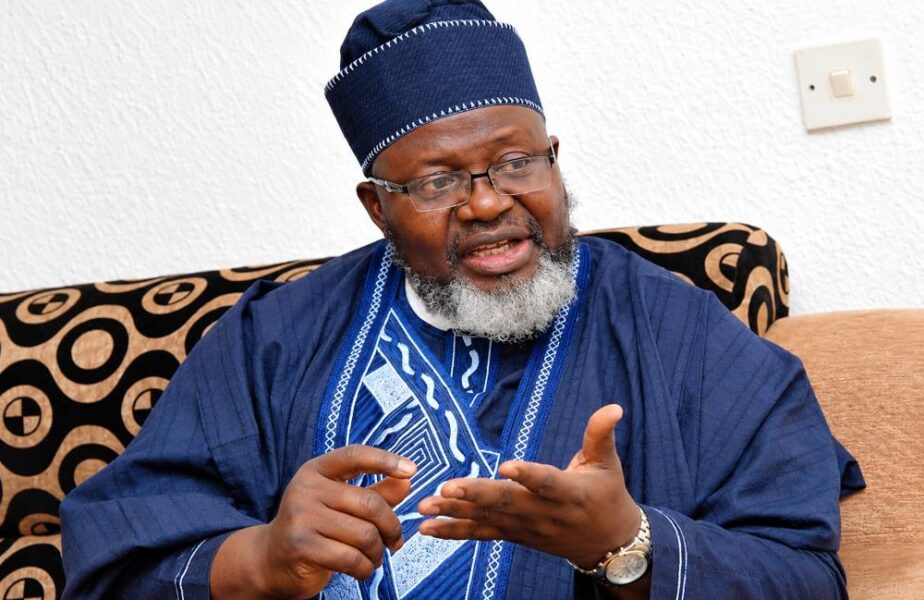

Former Minister of Communications, Adebayo Shittu, has called on the Federal Government to prioritise free access to education and human-capital development, arguing that student loans place additional financial burdens on young Nigerians, many of whom struggle to secure employment after graduation.
Shittu made the call on Tuesday, during an interview on Frontline, a current affairs programme on Eagle 102.5 FM, Ilese-Ijebu, Ogun State.
He argued that education should be treated as a fundamental right and a responsibility of government rather than a financial obligation that forces students from poor backgrounds into debt.
The former minister questioned the rationale behind introducing loans for students when many Nigerian graduates remain unemployed for years after completing their university education.
“Today, we have in this country graduates who graduated ten years ago and are still looking for jobs. They don’t have jobs and they are talking about giving them loans. I don’t believe in loans. I believe in fundamental rights,” he said.
Shittu urged the Federal Government to reconsider its approach to education financing, stressing that access to education should be addressed alongside employment opportunities, healthcare and the general welfare of citizens.
Shittu cites constitutional provisions on education
The former minister challenged Nigerians to examine the education objectives contained in the 1999 Constitution, arguing that the government has a responsibility to create conditions that enable citizens to acquire education and develop their potential.
“I challenge everyone to go and look at the education objectives in the Constitution of Nigeria, the 1999 Constitution,” he said.
Shittu maintained that government policies should focus on expanding educational opportunities for children from disadvantaged backgrounds instead of making access to higher education dependent on families’ financial circumstances.
He also invoked traditional communal values, arguing that responsibility for educating children should extend beyond individual households.
“In our local community, a child born into a community is the responsibility of the entire community to train, to educate and to provide for,” he said.
According to him, collective responsibility for children’s welfare should inform government policies on education and social development.
Former minister cites economic hardship among students
Shittu expressed concern about the economic difficulties confronting Nigerian households, particularly students who struggle to meet basic needs while pursuing their education.
He said he regularly receives messages from students who cannot afford necessities, including food, arguing that such experiences should influence how government evaluates its policies.
The former minister said the country’s available resources and expertise could be better deployed to improve access to education, healthcare and other essential services.
He also cited Rwanda as an example of a country that has invested significantly in human development, arguing that Nigeria should give greater attention to developing its human resources.
Shittu noted that previous administrations had invested in free education, healthcare and other social services, suggesting that the current government should also examine how available resources could support similar interventions.
Shittu calls for investment in skills and employment
Beyond access to formal education, the former minister called for greater government attention to employment, vocational training and basic welfare.
He argued that investing in education would help equip young Nigerians with the knowledge and skills required to contribute meaningfully to society.
According to him, expanding educational opportunities and providing relevant skills would also help address future social challenges by improving young people’s prospects and participation in the economy.
Shittu maintained that government policies should ultimately be measured by their impact on ordinary Nigerians, especially children from poor families.
His comments come amid the Federal Government’s student loan programme, administered by the Nigerian Education Loan Fund (NELFUND), which provides eligible students with interest-free loans to cover institutional charges and upkeep.
NELFUND reported that it had disbursed ₦355.87 billion to students and institutions as of September 3, 2026, according to figures published by the Nigerian Guardian.
Shittu’s position centres on the argument that public investment in education, employment and human-capital development should take precedence over requiring young Nigerians to borrow money to finance their studies.