
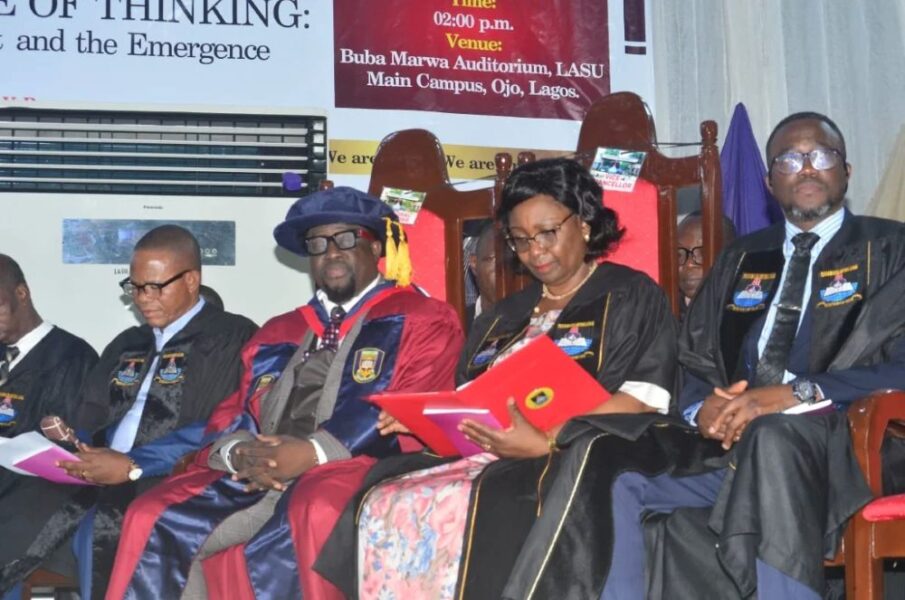

A professor of computer science at Lagos State University (LASU), Prof. Oluwatoyin Enikuomehin, has called on the Nigerian government to urgently enact a National Artificial Intelligence Act, warning that the rapid development of AI is outpacing existing governance frameworks.
Enikuomehin made the call on Tuesday while delivering LASU’s 127th Inaugural Lecture, titled “Thinking Machines and the Future of Thinking: Cyberphysicalism, the Transformation of Human Thought and the Emergence of an Artificial Intelligence Driven Algorithmic Society.”
The don said the central concern surrounding AI had shifted from whether machines could demonstrate intelligence to how the technology was changing human cognition, decision-making and memory.
According to him, people are increasingly “thinking with machines” as AI-powered devices and platforms become integrated into everyday activities.
“Before I was fully awake, I had checked messages, glanced at updates, responded to prompts and asked questions that required answers,” he said, illustrating how technology now influences human thought from the beginning of the day.
He warned that AI had evolved into a powerful extension of human intelligence, making effective regulation and accountability increasingly important.
To address the risks associated with biased, opaque or harmful AI systems, Enikuomehin unveiled an AI Governance Stack, a seven-layer framework designed to promote responsible and accountable deployment of artificial intelligence.
The framework comprises infrastructure security, data governance, algorithmic accountability, explainability, ethical oversight, regulatory compliance and societal impact assessment.
“AI governance is a layered problem. Failure at any layer propagates upward and undermines the layers above it,” he said.
He explained that weaknesses in one area could undermine safeguards established elsewhere, noting that even a system with strong ethical oversight could produce biased results if its data governance mechanisms were inadequate.
Enikuomehin therefore called for a comprehensive Nigerian legislative framework that clearly defines governance requirements across the various layers of AI development and deployment.
He also proposed the establishment of an independent National AI Research and Governance Council to assess the social consequences of AI, advise government on policy and represent Nigeria at international AI governance forums.
Beyond regulation, the professor warned that poor digital infrastructure could worsen existing inequalities as AI adoption expands.
He advocated universal broadband coverage, affordable access to digital devices and reliable electricity, stressing that these were necessary if AI was to serve as an equalising technology rather than deepen the digital divide.
“Without universal broadband, affordable device access and reliable electricity, AI will deepen the inequalities it promises to address,” he said.
The lecturer also urged Nigerians to embrace the opportunities presented by AI without surrendering independent thought.
“Our memories are stored in the cloud, our decisions are influenced by algorithms, and our knowledge is increasingly co-created with machines,” he said.
He advised citizens to question and verify AI-generated information, exercise ethical judgement and safeguard their digital identities.
The professor described personal data as a “cognitive shadow” in an increasingly cyberphysical society, arguing that digital privacy should be viewed not only as a technological concern but also as an issue of human dignity.
Speaking at the event, the Vice-Chancellor of LASU, Prof. Ibiyemi Olatunji-Bello, described the lecture as highly stimulating and said it provided important insights into the changing relationship between humans and technology.
“It was a very stimulating lecture. There was no dull moment,” she said, adding that the presentation examined how AI, augmented systems and cyber-physical technologies were transforming human cognition and contributing to the emergence of an algorithmic society.
Olatunji-Bello also announced that Enikuomehin would be the first inaugural lecturer to receive the university’s newly introduced commemorative certificate for inaugural lecturers.
She said the professor had also been formally welcomed into the university’s Senate and Body of Professors.