
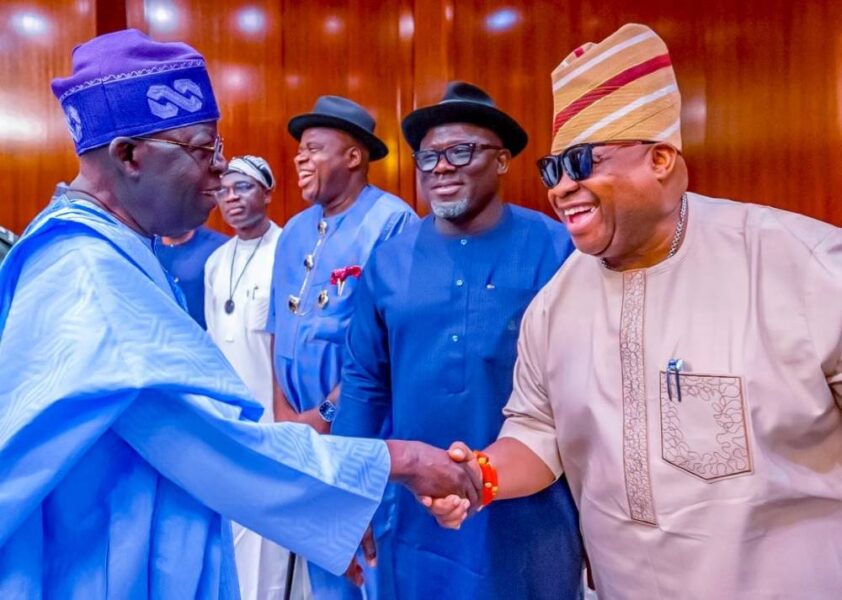

Rights activist and former Kaduna Central Senator, Shehu Sani, has described the emerging political relationship between Osun State Governor Ademola Adeleke and President Bola Tinubu as a strategic alliance driven by mutual interests rather than party ideology.
Sani said Adeleke and Tinubu had compelling political reasons to maintain a working relationship despite belonging to different political camps, particularly ahead of the 2027 presidential election.
The former lawmaker spoke on Tuesday as a guest on Frontline, a current affairs programme on Eagle 102.5 FM, Ilese-Ijebu, Ogun State.
Adeleke, who secured re-election in the August 15 Osun governorship election, recently thanked Tinubu for what he described as the president’s commitment to democratic principles and the credibility of the electoral process.
Following a congratulatory telephone call from Tinubu, Adeleke also declared his support for the president’s bid for a second term in 2027, citing the interests of the Southwest and the need for regional solidarity.
The endorsement has, however, triggered criticism from some of Adeleke’s supporters and opposition voices, who accused him of abandoning the political interests of those who supported him in the governorship election.
But Sani said Adeleke’s decision should be understood within the broader realities of Nigerian politics, where alliances are frequently shaped by political interests rather than ideological alignment.
“The people of Adeleke may not like Tinubu, and the people of Tinubu may not like Adeleke,” he said.
“But Tinubu needs Adeleke for the fact that he needs the votes from Osun State. Adeleke needs Tinubu for protection against the hawks that are coming in between them.”
According to Sani, Adeleke’s popularity in Osun has made him politically valuable to Tinubu as the president prepares for the 2027 election, while Tinubu’s influence at the federal level makes him equally important to Adeleke.
Sani specifically referred to the controversy over the freezing of Osun State Government accounts by the Economic and Financial Crimes Commission (EFCC) as an indication of the importance of the relationship.
He said Tinubu’s intervention to stop the EFCC from freezing the state’s accounts was done publicly and should therefore be viewed as politically significant.
“For Tinubu to stop the EFCC from freezing the account of Osun State, and he didn’t do it secretly, it was done openly for everyone to see,” Sani said.
He argued that Adeleke, having secured another four-year mandate, would still face political challenges requiring cooperation and protection at the federal level.
Sani also rejected the interpretation that the Osun election represented a major national defeat for the All Progressives Congress (APC) or automatically established the opposition as a formidable force ahead of 2027.
He said the peculiar relationship between Adeleke and Tinubu, alongside local political structures and individual interests, made it difficult to use the Osun result as a straightforward measure of national political strength.
The activist particularly criticised the African Democratic Congress (ADC) over its performance in the election, questioning the party’s claim to be a major opposition platform after its candidate, Najeem Salaam, reportedly secured only about 17,000 votes.
“What was their scorecard in Osun State?” Sani asked, arguing that the ADC should first examine its performance rather than concentrate solely on the APC’s defeat.
He also questioned how an opposition party could realistically pursue the presidency without establishing strong structures across the states and at the grassroots.
According to him, presidential candidates must support candidates contesting the House of Assembly, House of Representatives, Senate and local government elections because such candidates help create the grassroots structures required for national electoral success.
“If your candidates lost election, if your central candidates lost election, if your House of Assembly candidate lost election, and you say you want to be president of Nigeria, you are simply wasting your time,” he said.
Sani maintained that political strength must be built from the grassroots upwards, with candidates at different levels working together to mobilise voters.
He said the Osun election had exposed weaknesses within the ADC that the party would need to address if it intended to mount a credible challenge in the 2027 presidential election.
For Sani, the developing relationship between Adeleke and Tinubu is therefore less about party loyalty and more about intersecting political interests, with both leaders standing to gain from maintaining the alliance ahead of the next general election.