
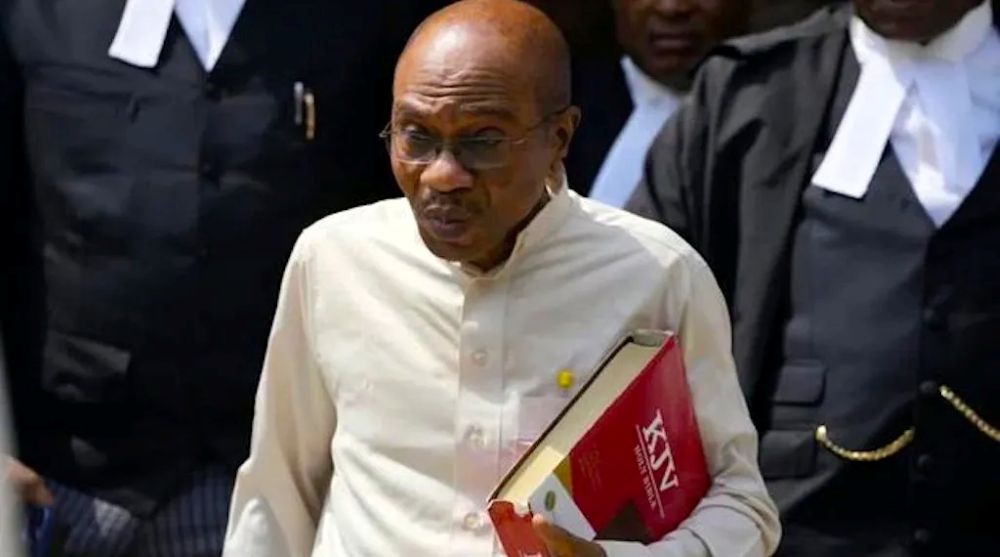

A High Court of the Federal Capital Territory sitting in Maitama, Abuja, on Tuesday ordered the Economic and Financial Crimes Commission (EFCC) to pay N500,000 in costs for delaying the ongoing trial of former Central Bank of Nigeria (CBN) governor, Godwin Emefiele.
The trial judge, Justice Hamza Muazu, imposed the monetary penalty after the prosecution failed to produce its witness at the resumed hearing of the case.
While granting what he described as a final adjournment, the judge cautioned the prosecution to ensure that its witnesses are present at the next hearing to avoid further delays.
Emefiele is facing a 20-count amended charge marked FCT/HC/CR/577/2023. The charges border on alleged criminal breach of trust, forgery, abuse of office, conspiracy, and obtaining money under false pretences.
Among the allegations, the former CBN governor is accused of unlawfully obtaining $6.23 million purportedly meant to fund international election observers during the 2023 general election. He is also accused of conferring corrupt advantages on two companies – April 1616 Nigeria Ltd and Architekon Nigeria Ltd.
At the resumed proceedings, prosecuting counsel, Abba Mohammed (SAN), informed the court that the prosecution’s witness, Deputy Commissioner of Police Elohor Edwin Okpoziakeo, was absent despite being duly notified of the hearing.
Mohammed explained that the witness was attending another court matter at the Gwagwalada Division of the FCT High Court involving a personal dispute with a commercial bank. According to the prosecutor, the case involved a garnishee order placed on the witness’s bank account.
He further told the court that steps had been taken to secure the witness’s appearance, including writing to the Inspector-General of Police through the Force Headquarters, in line with a directive issued on Monday.
Consequently, the prosecution applied for an adjournment to enable the witness to testify.
However, defence counsel, Matthew Burkaa (SAN), strongly opposed the request. He cited Sections 396(3) and (4) of the Administration of Criminal Justice Act (ACJA), 2015, which stipulate that parties in a criminal trial are limited to five adjournments from arraignment to judgment.
Burkaa argued that the prosecution had already exceeded the statutory limit, stating that about eight adjournments had been granted since the trial commenced.
He further contended that the prosecution failed to properly manage its case, noting that the witness had been listed in the proof of evidence since January 2024, giving the prosecution ample time to ensure his attendance in court.
The defence subsequently urged the court to refuse the request for another adjournment.
In his ruling, Justice Muazu acknowledged that the provisions of the ACJA regarding adjournments are clear. However, he held that the court retains discretionary powers to grant adjournments where necessary in the interest of justice.
The judge noted that the absent witness was the investigator in the case and therefore a material witness whose testimony was essential to the prosecution’s case.
Relying on Section 396(6) of the ACJA, Justice Muazu granted the adjournment but ordered the EFCC to pay N500,000 in costs for causing delays, particularly after the court had earlier granted accelerated hearing of the matter.
The court subsequently adjourned the trial to April 27 and April 28 for continuation of hearing.