
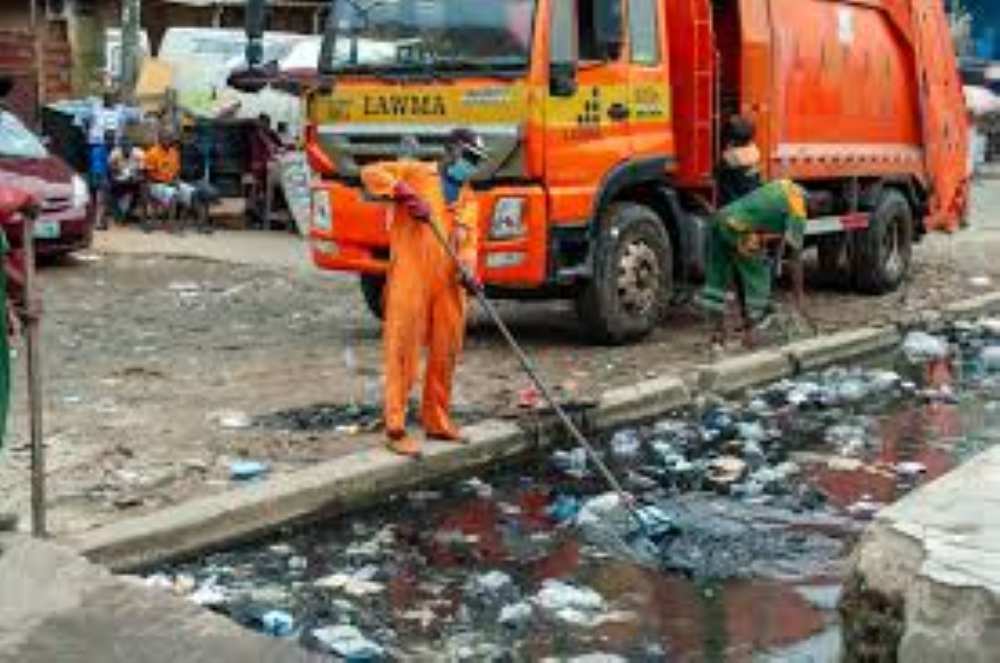

The Lagos State Government has unveiled a major investment plan to modernise its waste management system, announcing the procurement of 100 new compressed natural gas (CNG) compactor trucks in 2026 as part of a decade-long overhaul of the state’s sanitation fleet.
The disclosure was made by the Managing Director of the Lagos Waste Management Authority (LAWMA), Dr. Muyiwa Gbadegesin, during a media parley held on Wednesday in Alausa, Ikeja. A statement issued on Friday by the Director of Public Affairs, Ministry of Environment and Water Resources, Kunle Adeshina, confirmed the development.
Gbadegesin said the long-term programme aims to introduce between 200 and 250 additional trucks annually, enabling the state to gradually achieve an estimated requirement of 2,000 compactor trucks, 1,000 for daily operations and another 1,000 as backup.
According to him, the initiative aligns with the state’s transition to cleaner, CNG-powered vehicles and ongoing reforms designed to reduce emissions, curb environmental infractions, and strengthen service efficiency across the waste-management value chain.
New billing framework and PSP restructuring
The LAWMA boss said the state’s investment will be supported by a redesigned billing structure under which households will be enumerated and billed directly by the government. Payments to Private Sector Participation (PSP) operators will be tied to verified service delivery through an automated platform that ensures transparency and accountability.
He noted that residents are more willing to pay for waste collection when service delivery is consistent. “We believe Lagos residents are ready to pay for waste collection if they get good service, and that is what we will ensure going forward,” he said.
Gbadegesin revealed that LAWMA terminated the contracts of 22 PSP operators in 2025 due to underperformance, with affected service zones reassigned to new operators better equipped to meet operational benchmarks. The restructuring forms part of wider efforts to strengthen regulation and reduce the influence of informal waste handlers.
The agency also plans to deploy 500 mobile tricycle compactor units by mid-2026 to improve waste collection in densely populated communities with narrow or inaccessible roads. Gbadegesin referenced a successful pilot scheme in Ibeju-Lekki, initiated through a partnership between the local council chairman, Sesan Olowa, and a private investor.
He said the state intends to replicate the model across other local government areas, adding that the units would help absorb informal cart pushers by integrating them into structured PSP operations. “The PSP operators can buy some, engage cart pushers and put them on a salary. We can now have a more efficient system for Lagos,” he said.
Environmental experts believe the additional tricycle compactors could significantly ease the city’s daily waste burden, currently estimated at over 13,000 tonnes.
Gbadegesin warned residents against indiscriminate dumping of refuse on roads and waterways, stressing that offenders would be sanctioned under existing sanitation laws. He encouraged households to embrace waste sorting, noting that “90 per cent of what you throw away has value,” and reiterated the state’s commitment to a waste-to-wealth strategy that strengthens recycling and resource recovery.
He further confirmed that Lagos has commenced the decommissioning of the Olusosun and Solous 3 landfill sites, a process expected to be completed within 18 months. Two months of the transition period have already elapsed. The closure of open dumps is part of the state’s broader agenda to shift towards material-recovery facilities and waste-to-energy systems.
“In Lagos, we must move to a point where we ban landfill sites, and that is what we are moving towards as a state government,” he added.
The waste-to-energy transition is seen as the next critical phase of the state’s environmental strategy, positioning Lagos for cleaner, more sustainable urban waste management.