
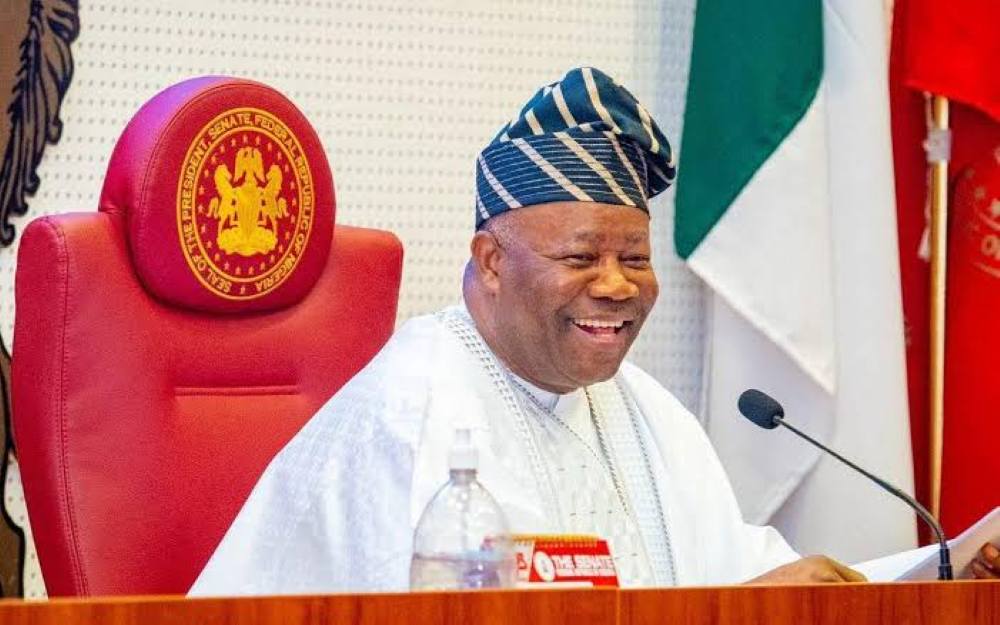

Senate President Godswill Akpabio has said the ongoing amendment of the Electoral Act 2022 has not been concluded, assuring Nigerians that there remains room for further adjustments before the final version is transmitted to the president for assent.
Akpabio spoke on Saturday in Abuja at the public presentation of a book titled The Burden of Legislators in Nigeria, authored by former senator Effiong Bob and published by Premium Times Books.
His comments come amid mounting public backlash following the Senate’s passage, on Wednesday, of the Electoral Act Amendment Bill. During the consideration of the bill, the upper chamber rejected provisions mandating the real-time electronic transmission of election results from polling units to the Independent National Electoral Commission (INEC), reduced certain electoral timelines for political parties, and declined to approve a proposed 10-year jail term for the buying and selling of Permanent Voters’ Cards (PVCs).
The Senate also recommended a clause allowing voters to download missing or unissued PVCs, a move that equally attracted mixed reactions from stakeholders.
Since the bill was passed, civil society organisations, opposition parties and sections of the public have criticised the decisions, describing them as a setback for electoral transparency, integrity and democratic accountability.
Addressing the criticisms, Akpabio stressed that the legislative process was far from complete, saying a bill goes through several internal stages before it can be considered final.
“In this case, we are yet to complete the process,” the Senate President said. “So why are people setting up panels in all television studios? People have suddenly become mouth legislators.”
He explained that the National Assembly operates a harmonisation mechanism, often referred to as a conference committee, where differences between the versions passed by both chambers are resolved.
However, before that stage, the Senate must first approve its official votes and proceedings.
“When we bring out the votes and proceedings, any senator has a right to rise and say, ‘in clause three, this was what we agreed upon,’” Akpabio said. “If the verbatim record disagrees, we amend it before approval. That is the only point at which one can definitively say what the Senate has done or not done.”
Akpabio further assured that the Senate would ultimately ensure that the final law reflects the will of Nigerians and serves the broader national interest.
On the contentious issue of electronic transmission of election results, the Senate President reiterated that the legislature did not abolish the provision. Rather, he said lawmakers only removed language that made electronic transmission mandatory in “real time.”
According to him, the deletion of the phrase was intended to avoid potential legal disputes arising from network failures or technological disruptions during elections.
“All we said was that we should remove the word ‘real-time’,” he explained. “If there is a network or grid failure and results are delayed, someone could go to court and argue that it ought to have been real-time. We did not want to create that legal conundrum.”
He added that the discretion to determine the mode of result transmission, whether electronic or otherwise, should rest with INEC, as the body constitutionally empowered to conduct elections.
Akpabio recalled that the Senate had earlier clarified its position during plenary, following reports that lawmakers had rejected electronic transmission outright.
“The social media is already awash with reports that the Senate has rejected electronic transmission of results. That is not true,” he said. “What we did was to retain what existed in the previous law, which already allowed electronic transmission and was used in 2022.”
He maintained that the current Senate would not preside over a reversal of electoral gains, noting that credible elections were in the interest of both the country and legislators themselves.