
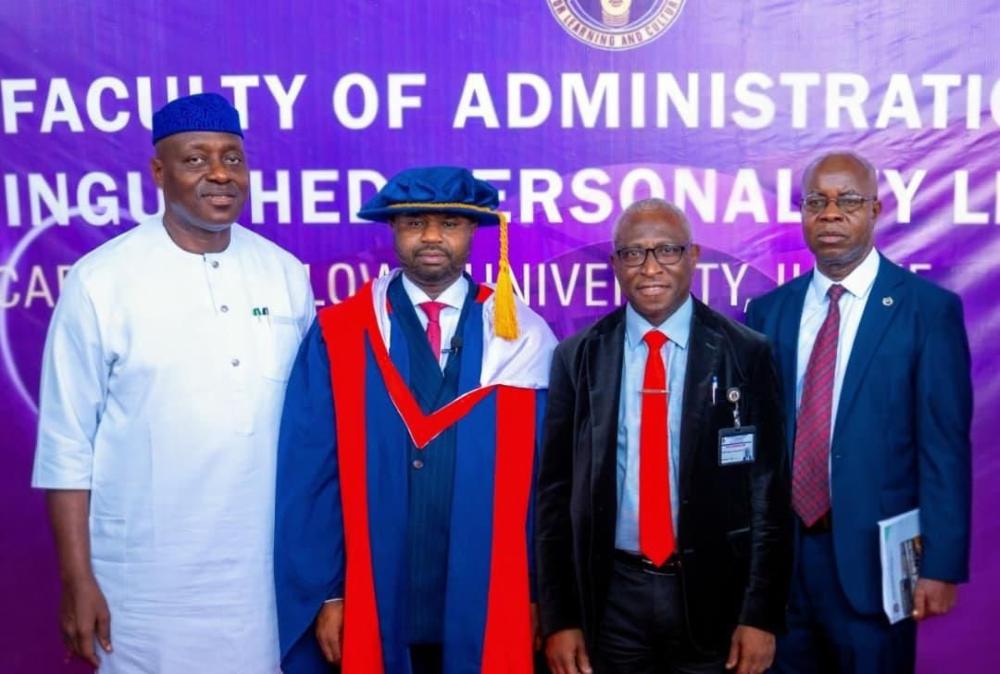

The Chairman of the Nigeria Revenue Service (NRS), Dr. Zacch Adedeji, has called for a fundamental rethinking of Nigeria’s economic growth strategy, urging the country to move away from overdependence on raw material exports toward innovation, ideas and the production of complex goods.
Adedeji made the call on Thursday while delivering the maiden Distinguished Personality Lecture of the Faculty of Administration at Obafemi Awolowo University, Ile-Ife, Osun State. His lecture was titled “From Potential to Prosperity: Export-led Economy.”
In a statement issued by his Special Adviser on Media, Dare Adekanmbi, Adedeji argued that sustainable growth could only be achieved if Nigeria embraced economic complexity rather than merely expanding the export of the same primary commodities.
He lamented that despite Nigeria’s vast endowments, the economy remains characterised by a narrow structure, with a high-tech oil sector existing alongside a low-productivity informal economy, and without a strong, labour-absorbing industrial base capable of driving diversification.
According to him, Nigeria’s export performance stagnated for nearly three decades between 1998 and 2023, adding only six new products to its export basket between 2008 and 2023.
He cited findings from the Harvard Atlas of Economic Complexity, which concluded that Nigeria currently has limited opportunities to diversify exports using existing capabilities.
Adedeji urged policymakers to learn from comparative global experiences, pointing to countries such as Vietnam, Bangladesh, Indonesia, South Africa and Brazil as examples of both success and missed opportunities.
“We are not just looking at numbers in a vacuum,” he said. “We are examining the strategic choices made by nations over the same twenty-five-year period. While there are many ways to underperform, the path to success is remarkably consistent: it requires a deliberate strategy to build economic complexity.”
He noted that Vietnam successfully leveraged global trade to build a resilient and diversified economy by integrating into global value chains, positioning itself as an assembly hub for electronics and other manufactured goods. Through this process, Vietnam was able to absorb technology, management expertise and industrial know-how.
By contrast, Adedeji observed that Nigeria has largely remained a supplier of raw materials to global value chains, rather than an active participant within them.
Citing South Africa and Brazil as examples of countries that lost industrial advantages due to overreliance on natural resources, the NRS boss warned that productive capabilities are not permanent.
“For Nigeria, which is even less diversified, the warning is stark,” he said. “Relying solely on natural endowments is not just a path to stagnation; it is a path to regression. The global economy increasingly rewards knowledge and complexity, not just what you can dig out of the ground.”
The NRS chairman added that the administration of President Bola Tinubu has begun the difficult process of economic rebuilding, aimed at strengthening collective capacity to innovate, produce and develop a more resilient economy.
“The journey from potential to prosperity is not a short one,” Adedeji concluded, “but with the right map and the right resolve, it is a journey Nigeria can finally complete.”