
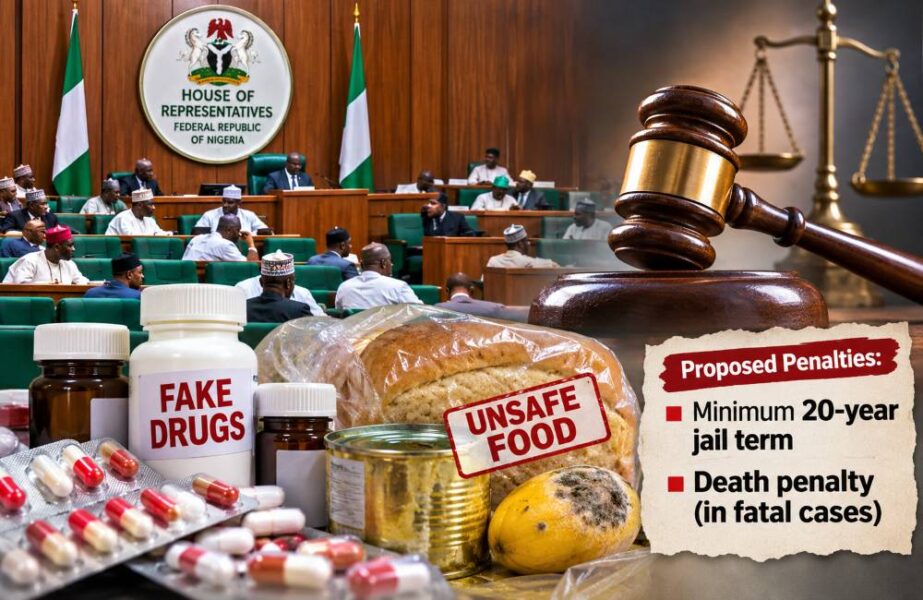

The House of Representatives is considering legislation that could impose a minimum 20-year prison sentence and the death penalty on individuals whose production or distribution of counterfeit drugs and unsafe processed foods results in loss of life.
The proposed amendments also seek to impose fines of up to ₦25 million on individuals and ₦100 million on corporate organisations convicted of relevant offences.
Sponsored by the Chairman of the House Committee on Public Assets, Hon. Ademorin Kuye, the three bills seek to strengthen existing laws regulating drugs, food and related products in Nigeria.
Kuye, who spoke in an interview on the proposed legislation, urged Nigerians and relevant stakeholders to support the bills, describing stronger sanctions as necessary to discourage the production and distribution of counterfeit medicines and unsafe food products.
He explained that the proposed death penalty would apply in cases where investigations and evidence establish that the consumption or use of prohibited products caused death.
According to the lawmaker, fake and substandard drugs, alongside expired, rotten, contaminated and adulterated food products, constitute serious threats to public health.
He identified possible consequences of consuming such products to include treatment failure, drug resistance, organ damage, kidney and liver failure, cancer, cholera, typhoid, dysentery and death.
One of the proposed legislations is the Counterfeit and Fake Drugs and Unwholesome Processed Foods (Miscellaneous Provisions) Act (Amendment) Bill, 2026 (HB. 2881).
The bill seeks to repeal and re-enact the existing Counterfeit and Fake Drugs and Unwholesome Processed Foods (Miscellaneous Provisions) Act, Cap C34, Laws of the Federation of Nigeria, 2004.
It proposes stricter restrictions on the sale and distribution of counterfeit, adulterated, banned, fake, substandard or expired drugs, as well as unwholesome processed foods.
Another bill seeks to amend the Food and Drug Act, Cap F32, Laws of the Federation of Nigeria, 2004, to introduce stiffer penalties for violations.
The third proposal, known as the Food, Drugs and Related Products (Registration, Etc.) Act (Amendment) Bill, 2026 (HB. 2880), seeks to strengthen sanctions for offences relating to the registration and regulation of food, drugs and related products.
Under the proposed amendment to Section 6(1) of the principal Act, anyone convicted of violating its provisions or regulations would face a fine of up to ₦25 million, imprisonment for a minimum of 20 years, or both.
Corporate organisations found guilty would face fines of up to ₦100 million.
The proposed legislation also seeks to lift the corporate veil, allowing individuals who use registered companies to conceal their involvement in the production or distribution of fake drugs and unsafe food products to be held personally accountable.
Kuye called on stakeholders to support the legislative process and urged the Executive to assent to the bills if they are passed by the National Assembly.
He maintained that tougher legal sanctions would help deter offenders and protect Nigerians from the potentially fatal consequences of consuming counterfeit medicines and contaminated food.