
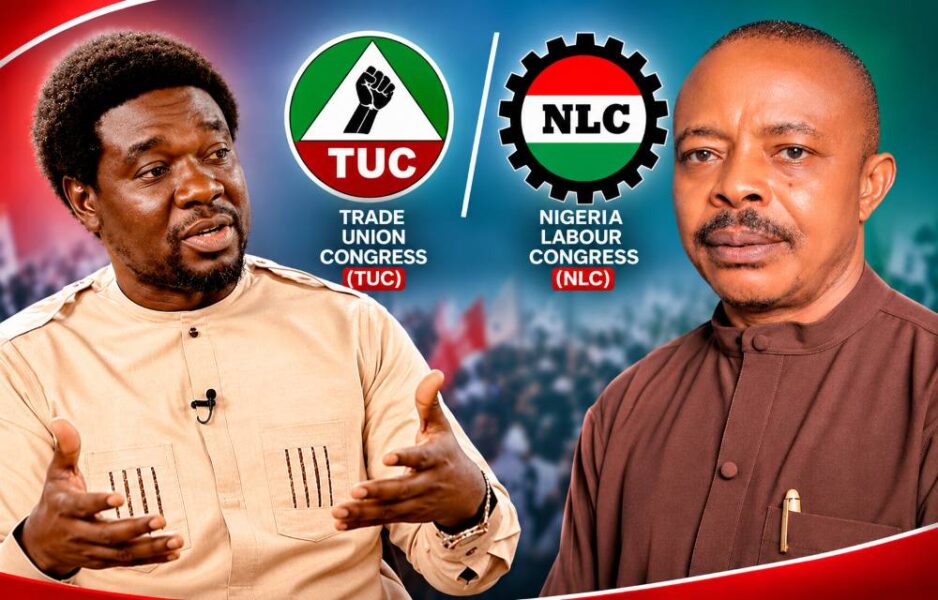

A fresh leadership rift has emerged within Nigeria’s organised labour movement as Nigeria Labour Congress (NLC) President Joe Ajaero and Trade Union Congress (TUC) President Festus Osifo publicly clashed over who has the authority to negotiate workers’ salaries, allowances and welfare with the Federal Government.
The disagreement, which played out on Channels Television’s The Morning Brief on Monday, centres on the interpretation of International Labour Organization (ILO) principles, the structure of organised labour and the controversial ₦70,000 transport intervention approved for workers.
Ajaero maintained that the NLC, as the labour centre with the larger number of workers’ representatives, has the authority to negotiate alone on labour matters, while the TUC can participate alongside it.
According to him, the ILO principle of majority representation gives the NLC a distinct negotiating position, insisting that the TUC cannot independently negotiate workers’ welfare with labour authorities.
“TUC can negotiate along with NLC, but NLC can negotiate alone based on the principle of most workers representatives of the ILO,” Ajaero said.
He further claimed that TUC proposals intended for the ILO must be channelled through the NLC, arguing that the NLC does not operate under a reciprocal arrangement with the TUC.
“TUC sent their negotiation alone ahead of the ILO conference, but they returned it, and I had to minute on it,” he said.
“They have to send their list here for me to forward it; that is the position of the ILO. NLC determines how TUC participates.”
Ajaero also argued that the Ministry of Labour and other government labour authorities would not recognise the TUC negotiating independently on workers’ welfare.
His position, however, drew an unusually blunt response from Osifo, who accused the NLC president of misrepresenting ILO regulations and attempting to claim authority over workers represented by the TUC.
Osifo described the N70,000 transport agreement as an “aberration”, alleging that the TUC was not carried along in the negotiations.
“I really pity the Labour movement and the quality of leaders that have been inflicted on the NLC,” Osifo said, before questioning whether the present leadership reflected the tradition of earlier NLC presidents such as Adams Oshiomhole, Hassan Sunmonu and Ayuba Wabba.
The TUC president challenged Ajaero to produce the ILO regulation that empowers one labour centre to negotiate on behalf of another.
“There is nowhere in ILO regulations that says a trade centre cannot negotiate for its members. It is not there!” Osifo declared.
He argued that although the NLC has more affiliates, that numerical advantage does not give it the right to negotiate on behalf of TUC-affiliated unions without their participation.
Osifo said the two labour centres should come together when negotiations involve workers represented by both organisations.
“We are not contesting the fact that NLC has more affiliates. But what we are saying is that you have about 60 affiliates while we have about 40. You cannot negotiate for a body that is represented, for a body that has a trade union,” he said.
The disagreement has exposed deeper differences over the Joint National Public Service Negotiating Council (JNC), with both labour leaders offering sharply contrasting interpretations of its authority and role.
Ajaero argued that only one TUC-affiliated union belongs to the eight-member JNC, while seven are affiliated to the NLC.
He also maintained that the TUC-affiliated union had subjected its negotiating authority to the joint body.
Osifo rejected Ajaero’s interpretation, accusing him of misunderstanding the JNC’s constitution and contemporary industrial relations.
“I don’t truly think Ajaero has read the JNC constitution. I don’t truly think he knows what the JNC means,” Osifo said.
He also criticised the use of the JNC in determining the implementation of the latest minimum wage, particularly the application of the ₦40,000 difference between the former ₦30,000 minimum wage and the new ₦70,000 wage.
According to Osifo, the approach resulted in federal workers receiving inadequate consequential adjustments.
He recalled confronting Ajaero personally over the matter, saying: “Ajaero, this is wrong!”
Beyond their disagreement over procedure, the public exchange points to a more fundamental struggle over representation within Nigeria’s labour movement: whether numerical strength gives one labour centre the right to negotiate for workers represented by another.
The confrontation places the unity and negotiating strength of Nigeria’s two major labour centres under fresh scrutiny at a time when workers’ wages, allowances and welfare remain major national issues.