
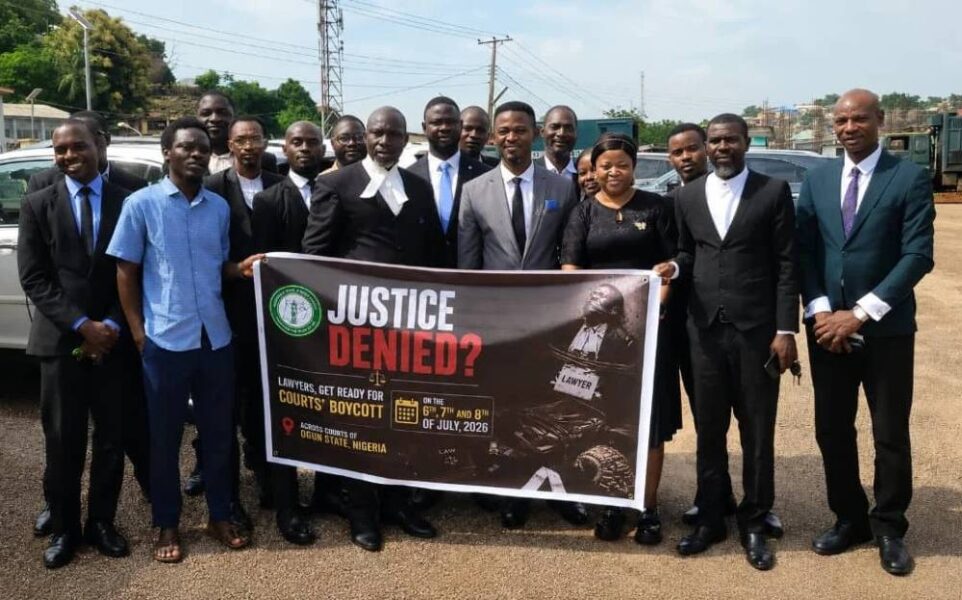

Members of the Nigerian Bar Association (NBA) in Abeokuta, Sagamu and Ota on Monday commenced a three-day boycott of court proceedings in protest against policies introduced by the Ogun State Judiciary, including a ₦100,000 charge for virtual court hearings.
The industrial action, which runs from July 6 to July 8, follows what the lawyers described as unsuccessful efforts to persuade the judiciary to review the controversial measures through dialogue.
Speaking with journalists after monitoring compliance at Magistrates’ and High Courts in Abeokuta, Chairman of the NBA Abeokuta Branch, Kayode Aderemi, said the decision was reached during a branch meeting after repeated engagements with judicial authorities failed to produce any changes.
According to him, the lawyers are objecting to the introduction of a ₦100,000 fee for each virtual court session, an increase in the cost of administering oaths from ₦200 to more than ₦1,500, and restrictions limiting lawyers to processing only four witness oaths daily.
Aderemi argued that the policies place unnecessary financial burdens on litigants and hinder legal practitioners from effectively carrying out their duties.
“We are here today because members of our branch resolved to embark on a three-day court boycott beginning today through July 8. The boycott is in protest against certain policies of the Ogun State Judiciary which we believe are inimical to the interests of our members,” he said.
He maintained that charging ₦100,000 for every virtual hearing would make remote proceedings unaffordable for many litigants, while the increase in oath administration fees had triggered complaints from clients.
He also questioned the restriction on witness oaths, noting that lawyers handling cases involving numerous witnesses would be unable to complete the required documentation within a reasonable time.
“If I have 15 or more witnesses in a case, what happens? We believe this policy unjustifiably limits the ability of lawyers to carry out their professional duties,” Aderemi added.
The NBA chairman said the association had exhausted available channels to seek a review of the policies before resorting to the boycott.
According to him, letters were sent by various NBA branches in Ogun State, while the issues were repeatedly discussed during meetings of the Bar and Bench Forum attended by branch leaders, administrative judges and the Chief Judge.
He added that senior members of the Bar also held discussions with judicial authorities without success.
Aderemi said the boycott was jointly observed by the Abeokuta, Ota and Sagamu branches of the NBA, adding that compliance across the affected courts had been encouraging.
However, the Ogun State Judiciary denied receiving any formal notice of the industrial action.
Chief Registrar of the Ogun State High Court, Olakulehin Oke, said the judiciary only became aware of the boycott through social media, insisting that no official communication had been received from any NBA branch.
“Officially, we have not been informed. We became aware of the boycott the same way many others did—through social media,” Oke said.
Responding to concerns over the ₦100,000 virtual hearing fee, Oke explained that the provision was introduced under the High Court of Ogun State (Civil Procedure) Rules 2024 after consultations with NBA branches across the state.
He disclosed that draft copies of the rules were circulated to all five NBA branches before implementation, but only one branch responded, identifying typographical errors rather than objecting to the provision.
Oke stressed that virtual hearings remain optional and were introduced to improve access to justice rather than replace physical court sittings.
According to him, establishing and maintaining virtual court facilities requires substantial investment, noting that virtual courtrooms have been installed in nine of the state’s 11 judicial divisions, with more than 600 virtual hearings conducted since the initiative began.
He added that the technology had enabled witnesses from countries such as Australia, Canada and the United States to testify remotely, reducing travel costs and delays.
The Chief Registrar also defended the increase in affidavit-related charges, describing it as part of the judiciary’s digitalisation programme through the OgunComis electronic affidavit platform.
He said the platform was introduced to eliminate cash transactions, prevent forgery and improve the authentication of affidavits, adding that similar systems are already operational in Oyo, Ondo, Rivers, Lagos and the Federal Capital Territory.
On complaints about affidavit restrictions, Oke clarified that the limitation applies only to general affidavits, including declarations of age, change of name and loss of documents, and not to affidavits connected with ongoing court proceedings.
He explained that witness statements on oath and affidavits filed as part of court processes remain unrestricted.
Describing the boycott as unfortunate, Oke said discussions on the disputed policies were still ongoing through the judiciary’s Bar and Bench Forum.
He urged both the Bar and the Bench to resolve their differences through dialogue, stressing that both institutions remain partners in the administration of justice.