
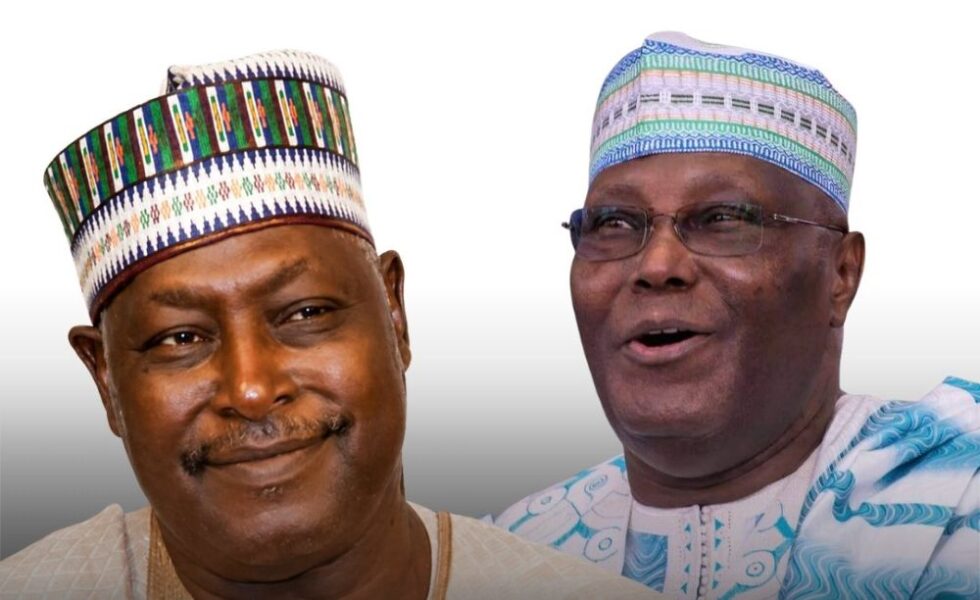

Former Secretary to the Government of the Federation, Babachir David Lawal, has launched a scathing attack on former Vice President Atiku Abubakar, accusing him of lacking empathy for Nigerians and describing opposition coalition politics as being driven largely by personal ambition ahead of the 2027 general elections.
Lawal made the remarks during an interview on Frontline, a current affairs programme on Eagle 102.5 FM in Ogun State, shortly after he resigned from the African Democratic Congress (ADC) following controversies surrounding the party’s presidential primary.
The former SGF had officially exited the ADC on Monday, alleging widespread irregularities in the party’s primary election, which he claimed was manipulated in favour of Atiku. He described the process as fraudulent and insisted he could not remain part of what he termed a “rigging machine”.
Lawal, who has temporarily withdrawn to Adamawa State to consult political associates before deciding his next move, said his criticism of Atiku was not personal but rooted in concerns over leadership style, public conduct and national engagement.
Questioning Atiku’s connection with ordinary Nigerians, Lawal argued that the former vice president had failed to show sufficient empathy during periods of insecurity and national hardship. He claimed Atiku had rarely been visibly present in communities affected by insurgency or violent attacks, adding that leadership requires emotional and physical engagement with citizens.
According to him, Nigerians, particularly those in rural areas, continue to bear the heaviest burden of insecurity and economic challenges while political leaders remain detached from their realities.
Lawal also criticised coalition politics in Nigeria, saying most alliances collapse because politicians are more interested in securing presidential tickets than building ideological or governance-based structures. He argued that once individuals sense they may not emerge as consensus candidates, they quickly abandon coalition arrangements in search of alternatives.
Reflecting on the formation of the ADC coalition, Lawal said he joined the movement out of concern over what he called the “disastrous policies” of President Bola Tinubu’s administration rather than personal political ambition. He, however, lamented that the coalition eventually became weakened by internal rivalry and competing ambitions among key actors.
The former SGF further accused political parties of undermining democracy through manipulated primaries and controversial consensus arrangements. He said democratic credibility suffers when delegates are arbitrarily counted or candidates imposed without transparent elections.
On opposition figures positioning for 2027, Lawal assessed several potential contenders, including Peter Obi, Rotimi Amaechi and Mohammad Hayatu-Deen. While expressing doubts about Amaechi’s national electoral appeal, he described Hayatu-Deen as the most competent among those he considered, citing his corporate and economic experience.
He also revealed that coalition discussions around Peter Obi were often unstable, claiming there were concerns over whether the former Labour Party presidential candidate was fully committed to the alliance arrangement.
Lawal additionally criticised the composition of Atiku’s political entourage, alleging that it lacked broad national representation. According to him, Nigerians should examine not only campaign promises but also the networks and alliances surrounding presidential aspirants, as they often reflect leadership style and inclusiveness.
The former SGF revisited the long-standing political rift between former President Olusegun Obasanjo and Atiku, describing it as evidence of deep trust deficits within Nigeria’s political elite. He argued that the disputes between both men during their years in government continue to shape public perceptions about Atiku’s political career.
Lawal also defended himself against past corruption allegations linked to his tenure as SGF, insisting that the Economic and Financial Crimes Commission investigated and cleared him. He maintained that the case against him was politically motivated and eventually dismissed in court on a no-case submission basis.
Concluding his remarks, Lawal insisted that Nigeria’s future depends on electing leaders capable of demonstrating empathy, competence and national inclusiveness. He warned that failure to prioritise credible leadership would continue to weaken public trust in democratic institutions and worsen governance challenges across the country.